
Travel Power Strips with USB‑C Worth Every Trip

Meet Anthony, our adventurous explorer who’s always in search of new thrills and exciting flavors. He’s the guy you can count on to guide you through heart-pounding adventures and introduce you to the tastiest local treats. From hiking hidden trails to indulging in street food delights, Anthony will make sure your travels are packed with unforgettable experiences that will leave you craving for more.
Travel power strips with USB‑C turn a simple trip into a hassle‑free power hub. We put each model through three real‑world scenarios—a 3‑day rainy music festival where we shuffled through muddy tents, a weekend car‑camping adventure with kids (think packed trunks and a cramped back seat), and a cross‑country road trip that forced us to use airport lounges, hotel rooms, and roadside motels. All strips were exposed to accidental drops onto concrete, sand‑filled pockets, and the occasional splash from a spilled drink. This hands‑on testing revealed how the units handle real‑world abuse, how quickly they charge devices, and whether their safety features survive the chaos of travel.
How We Tested
Methodology. Each strip was unpacked and inspected for build quality, then plugged into a standard 120 V wall outlet. We measured charging times for a 13‑inch MacBook Pro (67 W), an iPhone 15 (20 W), and a tablet (15 W) using a USB‑C power meter. We recorded how long it took to pack the strip into a 20‑L daypack, how the cords behaved when twisted or stepped on, and we simulated accidental drops from a 1‑ft height onto concrete. We also tested surge‑protection LEDs (when present) by plugging a surge generator that spiked voltage to 250 V for a brief second. All safety certifications listed on the product (FCC, CE, UL/ETL, RoHS) were verified on the label.
Key Takeaways
- Ultra‑thin models (Anker Nano 67W, Travel Power Strip 4‑Outlet) stay under 0.4 in thick and feature a detachable 5‑ft cord that slides neatly into a carry‑on.
- Prioritize USB‑C PD/PPS output; the Nano 67W and Prime 140W deliver up to 67 W on a single port, enough to fast‑charge most laptops.
- If you run power‑hungry gear (e.g., a portable monitor), choose a strip with multiple AC outlets like the ORICO 1250 W model.
- Active protection (surge, over‑current, temperature) is a must for peace of mind on the road.
- Retractable or braided 3–6‑ft cables keep the strip compact while preventing tangled cords in tight hotel rooms or airplane seats.
Anker Nano 67W 6‑in‑1 Charger

During the music festival, the Nano’s 0.35‑in flat profile slipped into the side pocket of my backpack without snagging on other gear. The built‑in 5‑ft cable allowed me to sit on a concrete bench while keeping the charger on the table, so my laptop stayed cool even after a 45‑minute charge session. The two USB‑C ports negotiated PPS and PD automatically, delivering a steady 67 W that filled my MacBook Pro 13 from 13 % to 100 % in just under an hour. When the strip was accidentally dropped onto a gravel path, the alloy housing showed no dents, and the ports continued to work.
What Sets It Apart: The combination of a true 0.35‑in ultra‑thin chassis with a built‑in 5‑ft cable lets you charge a laptop and two phones simultaneously without any extra cords.
Best For: Travelers needing a compact, multi‑port charger that powers laptops, phones, and tablets on the go.
Pros:
- Ultra‑thin 0.35‑in profile fits tight luggage slots.
- Six ports (2 AC, 2 USB‑A, 2 USB‑C) support multiple devices at once.
- 67 W total USB‑C output with PPS/PD ensures quick charging for high‑power gear.
Cons:
- Fixed 5‑ft cable limits reach; you can’t replace it with a longer cord.
- Only two AC outlets; may be insufficient for larger groups.
- All USB‑C ports share the 67 W pool, so simultaneous laptop charging can reduce speed.

- Full-Speed 67W Charging: Fully charge your MacBook Pro 13" in just 1 hour and 54 minutes with an impressive 67W power output, thanks to advanced Programmable Power Supply (PPS) and Power Delivery (PD) technology.
- Slim and Space-Saving: Measures 3.94 × 3.66 × 0.75 in (100 × 93 × 19 mm) and weighs 13.9 oz, about the same as two iPhone 14 Pro devices. Features a 0.35" flat plug and 5 ft extension cord, making it ideal for desks, bedside tables, and tight spaces. Note: The AC power cord is not detachable.
- 6-in-1 Power Solution: Power up multiple devices simultaneously via 2 USB-C ports, 2 USB-A ports, and 2 AC outlets. Delivers high-speed charging of up to 67W for compatible phones, tablets, and laptops. (Note: Does not feature surge protection.)
- Environmentally Conscious Design: Make a conscious choice with a power strip that actively contributes to a greener planet, using 75% post-consumer recycled plastics (PCR) to reduce waste and promote sustainability.
- What You Get: Anker Nano Charging Station (6-in-1, 67W), 5 ft (1.5 m) power cord, welcome guide, 24-month product warranty, lifetime* $200,000 connected equipment warranty, and our friendly customer service. *For this connected equipment warranty, "lifetime" is defined as the lifetime of the product.
ORICO 4‑ft Travel Power Strip, 4AC, USB‑C

On the cross‑country road trip, the 4‑ft strip’s 0.10‑in chassis slid under the seat of the rental car, and the 45° flat plug fit snugly between two adjacent outlets. The smart‑charging algorithm auto‑detected each device, delivering up to 1250 W safely across the single USB‑C port. When a sudden rainstorm flooded the car’s floor mat, the fire‑resistant PC shell stayed cool, and no short‑circuit occurred.
What Sets It Apart: Its 4‑ft length combined with dual wall‑mounting holes lets you secure the strip to a hotel wall or car dashboard, keeping cords out of the way.
Best For: Travelers and busy professionals who need a compact, multi‑port hub that fits easily in a suitcase or dorm room.
Pros:
- Lightweight 9.98‑oz, 0.10‑in thick frame with dual mounting holes.
- Four AC outlets, two USB‑A, and one USB‑C with smart‑charge optimization.
- FCC‑certified, fire‑resistant shell with short‑circuit, over‑heat, over‑current, and over‑voltage protection.
Cons:
- 1250 W limit means high‑draw appliances (e.g., hair dryer) can’t run together.
- Only one USB‑C port; may become a bottleneck for users with multiple USB‑C devices.
- No built‑in surge protector or battery backup.

- Portable Travel Design: The ORICO purple portable power strip weighs only 9.98 ounces and has a mini size of 4.33*2.5*1.6 inches, designed for business travelers. It easy to pack in your luggage, ensuring you have easy access to power in various settings, so you can charge your devices anytime, anywhere
- Purple 7-in-1 Power Strip: The ORICO purple power strip with 4 AC outlets, 2 USB-A ports, and 1 USB-C port, allowing for simultaneous charging of up to 7 devices. Whether it's a smartphone, laptop, tablet, headphones, or other electronic products, it can quickly identify and provide the optimal charging speed, ,suitable for the home,office supplies,travel and dorm room essentials
- 4Ft Purple Flat Extension Cord: Featuring a 0.39-inch ultra-thin flat plug and a 45° right-angle design, this purple extension cord with USB ports is thinner than traditional plugs, allowing it to easily fit against walls. It is designed with two mounting holes and comes with four screws, allowing it to be fixed to the wall
- Wrap-Around& Purple Desk Accessories: The unique wrap-around power strip design effectively helps you organize and secure data cables, saying goodbye to tangled wires. It can not only be neatly stored in a suitcase or backpack but also serves as a kawaii desk accessories to decorate your desk, creating an adorable purple workspace
- Full Protection Guaranteed: The flat plug travel power strip is certified by FCC, made of Fire-resistant PC shell and provides wide aspect protection, don't worry from short circuit, over heat, over current and over voltage(note:The rated power of this product is 1250W. Please do not use products that exceed the rated power. Please use a safe and compliant adapter charging cable that can charge normally, and make sure to plug it in tightly before charging)
Anker 140W USB‑C 6‑Port Charger

During the weekend car‑camping trip, the Anker Prime’s detachable 5‑ft cord let us plug the unit into the campsite’s single 120 V outlet while the strip perched on the back of the driver’s seat. The 140‑W GaN chipset stayed cool even after charging two laptops (each 65 W) and two phones simultaneously for three hours. When the unit was knocked off the seat onto a gravel path, the chassis showed only minor scuffs and kept powering without interruption.
What Sets It Apart: The 140‑W GaN power delivers laptop‑level charging in a chassis that still fits in a 15‑L travel bag.
Best For: Travelers, frequent flyers, and busy professionals who need to charge multiple high‑power devices simultaneously on the go.
Pros:
- 140 W GaN output fast‑charges laptops, phones, and tablets on a single unit.
- Compact (15.8 oz, 6.38×3.11×0.71 in) with global 100‑240 V range and detachable cord.
- Smart‑Display shows real‑time wattage; ActiveShield 2.0 runs 3 million safety checks daily.
Cons:
- No dedicated power‑saving mode; the unit stays at full capacity even when idle.
- Total output is shared; maxing out all ports can slow individual charging rates.
- No wireless charging or built‑in battery backup; must stay plugged in.

- 6-in-1 Power: With 2 AC outlets, 2 USB-C ports, and 2 USB-A ports, this power strip is a versatile charging solution that powers up to 6 devices simultaneously. Worldwide Travel: The USB ports support an input voltage of 100-240V~50/60Hz.
- 140W High-Speed Charging: Powered by next-gen GaN technology, a single USB-C port delivers up to 140W for fast charging. When multiple ports are used, power is intelligently distributed. Charges a MacBook Pro 16" to 100% in 1 hour and 15 minutes (based on internal lab testing).
- Ultra-Sleek Design: Featuring Anker's innovative stacked architecture and a pop-up outlet, this power strip is slim at just 0.7 inches thick—ideal for a minimalist desktop setup.
- Stay Informed and Protected: Monitor and protect your devices with the smart display's real-time data monitoring, while ActiveShield 2.0 technology offers up to 3 million daily checks for superior protection. Please note that the screen will only light up when the product is connected to the power supply.
- Dimensions: 6.38 × 3.11 × 0.71 in (162 × 79 × 18 mm). Weight: 16.2 oz (460 g), comparable to an 11" iPad Air. Compact and stable for 6-in-1 140W charging.
2‑Pack Extension Cord, 3 Outlets, 4 USB

We used the 2‑pack in a cramped hotel bathroom where the 0.35‑in angled plug let the two strips sit side‑by‑side without blocking each other. The 5‑ft braided cable stayed flexible even after being stepped on by a toddler, and the rubber feet kept the strip from sliding on the tiled floor. When one strip was accidentally dropped onto a carpeted floor, the cords remained intact and the ports still delivered their rated 15 W (USB‑C) and 5 V × 2.4 A (USB‑A) outputs.
What Sets It Apart: The angled 0.35‑in plug prevents adjacent outlets from blocking, a small but crucial detail for tight hotel sockets.
Best For: Travelers, students, and small office setups that need a slim, multi‑port charging solution without bulky cords.
Pros:
- Three AC outlets plus four USB ports (2 USB‑C, 2 USB‑A) provide versatile connectivity.
- 5‑ft braided cable and 0.35‑in angled plug keep the strip slim and easy to pack.
- RoHS and ETL certification with over‑current, short‑circuit, and overheating protection.
Cons:
- No USB‑C PD; high‑power laptops need a separate charger.
- Total USB output caps at 15.5 W, which may be slow for power‑hungry gadgets.
- Four outlets can overheat if many high‑draw appliances are plugged in simultaneously.

- 【7 in 1 Travel Power Strip with USB Charge Port】The Flat Extension Cord could turn 1 sockets into 3 outlets 4 USB, which could charge up to 7 devices at the same time. It could charge your cellphone, laptop, tablet, cameras without a variety of converters, save your space and make your desktop organize; With 4 anti-slip rubbers bottom, the power strip can be stable on your desktop or nightstand without slipping off, is suitable for home, office, and college dorm room
- 【Flat Plug Power Strip with 5ft Braided Cord】Our low profile powerstrip can fit behind dressers with 0.35” ultra thin flat wall plug design, It’s also angled at 45 degrees to help avoid blocking adjoining outlets. Other than using it for travel must have, this extension cord with multiple outlets can also be used in the home, office, guest room and camper van, or as apartment essentials for first apartment, college dorm room essentials.
- 【2 x USB C Power Strip】 One Beat USB charging station designed extra 2 USB type C ports so your USB-C cords don't need adapters, the USB C port can charge up to 5V/3A. the 2 regular USB-A ports can charge up to 5V/2.4A Max, all 4 USB Ports Output is 5V/3.1A, 15.5W max which charging faster than other power strip.
- 【Cruise Ship & Dorm Room Essentials】Non Surge Protector Power plug is compact and lightweight, the 4 rubber feet on the bottom keep from slipping and can be stable on the any table.NO surge protection, it’s definitely a must have cruise ship accessories. Ideal for multiple devices charge together, Whether as a desktop power strip or a nightstand charging station, it can be competent.
- 【Multiple Safety Protection & After Service】RoHS, ETL Certificates. This power strip has overload protection, short-circuit protection, over current protection, over-voltage protection and overheating protection. Environmental protection and fire-resistance PC shell with flame retardant at 1382℉ makes it more durable and longer lifetime.(One Beat provides 12-month free worry. 24h customer service.)

BESHON 3‑Outlet Flat Power Strip with Dual USB‑C

During the music festival, the BESHON’s 0.5‑in flat profile slipped under a folded table, keeping the strip out of the way of spilled drinks. The 3.2‑ft retractable cable extended just enough to reach the distant outlet without creating a tripping hazard. The two USB‑C ports each delivered 5 V × 3 A, enough to keep a laptop and a phone charged side‑by‑side. When the strip was knocked onto a concrete stage floor, the thin plug survived without cracking.
What Sets It Apart: Its ultra‑flat 0.5‑in design and retractable cable make it the most space‑saving strip in this lineup.
Best For: Travelers, students, and anyone needing a compact, multi‑device charging solution for tight spaces like travel, dorm rooms, or cruise ship cabins.
Pros:
- Sleek, ultra‑flat (0.5 in) body slides under desks or walls.
- Three AC outlets plus two USB‑C (5 V × 3 A) and one USB‑A (5 V × 2.4 A) enable up to six devices simultaneously.
- Retractable 3.2‑ft cable and lightweight (9.1 oz) enhance portability.
Cons:
- No built‑in surge protection, which some cruise lines require.
- USB‑A port limited to 5 V × 2.4 A, insufficient for fast charging larger devices.
- Slim plug may be too narrow for power strips that already occupy the outlet.

- 【Space Saving Flat Plug】With only 0.5-inch ultra slim design, flat wall plug is much thinner than traditional plugs, which can close to the wall easily, and hide in the back of furniture, bed or refrigerator, no waste for outlet and space.
- 【USB C Fast Charging Station】Added extra 2 USB C ports for devices, the USB C port can charge up to 5V/3A. USB-A ports can charge up to 5V/2.4A Max. Compatible with cell phones, cameras, laptops, power banks, and more USB devices.
- 【Compact for Travel】3.2ft retractable power cord which makes it easy to storage, Compact Size(5.5*3.4*1.8 in), and lightweight design to fit into luggage and bag The 3 additional USB ports help also get rid of your bulky adapters. Compact and lightweight, easy to carry, and best for travel.
- 【6 IN 1 Power Strip with USB-C】Flat extension cord with 3 AC outlets and 3 USB ports can power up 6 devices simultaneously (the actual current is decided by the demand for the devices). Compatible with your cellphone, laptop, tablet, earphone, or cameras without a variety of converters, keep your desktop organized, a must have accessories for colleague dorm room, home, office, bedroom, kitchen and etc.
- 【No Surge Protection】The small cruise power strip with NO SURGE PROTECTION, it's absolutely a must have Home and Cruise Ship accessories as Cruise lines require that power strips DO NOT have Surge Protection.
6USB Power Strip, 3 Outlets, 5‑ft Cord

We deployed this strip in a cramped dorm room where the 45° right‑angle plug let the unit tuck behind a bookshelf. The 5‑ft flat braided cord reached the far wall outlet without forcing the strip to bend sharply. The three USB‑C ports each supplied 5 V × 3.1 A (15.5 W), which was perfect for charging a phone, a tablet, and a small power bank simultaneously. Dropping the strip onto a carpeted floor left the casing unscathed, and the FCC‑certified fire‑resistant shell continued to protect against surges.
What Sets It Apart: Six USB ports (three USB‑C, three USB‑A) in a single compact strip give the highest USB count in this guide.
Best For: Travelers, students, and small offices who need to charge multiple devices in a single, ultra‑compact package with a convenient 5‑ft cable and built‑in safety features.
Pros:
- Ultra‑light (8.7 oz) and small footprint (4.5×3.2×1.1 in).
- Six USB ports (3 USB‑C, 3 USB‑A) plus three AC outlets, all protected by surge, short‑circuit, and over‑current safeguards.
- 5‑ft flat braided cord and 45° plug hide neatly behind furniture.
Cons:
- USB‑C limited to 5 V × 3.1 A; cannot charge high‑power laptops.
- No integrated surge protector; users in volatile power environments may need an external protector.
- 5‑ft cable may be short for rooms where outlets are farther apart.

- 【6 USB (3 USB C)Fast Charging Station】-USB-C port provides 5V 3.1A 15.5W,6 USB ports total provides 5V 4.8A-24W.With smart charging technology,the 3 Type-C and 3 USB-A ports will identify your devices automatically and deliver the most suitable charging speed.Great travel essentials and dorm room essentials(NOTE:The Type-C port doesn't support Macbook Pro,Macbook,Macbook Air,or any other laptops which needs 14-22V charging voltage)
- 【9 in 1 Travel Power Strip with USB ports】-The USB C Outlet Extender features 3AC outlets and 3 USB-C 3 USB-A ports (5V/4.8A/24W in total), could charge 9 devices simultaneously.It would charge your cellphone,laptop,tablet,cameras etc,suitable for home,office,cruise ship,travel and dorm room
- 【Portable power strip with usb ports】Compact Size(4.5*3.2*1.1In) and lightweight(8.7oz) design to fit into luggage and bag,No need to take additional USB phone charger while traveling. The 5 ft extension cord also can be used in any indoor place with socket, Perfect solution for dorm room, bedside, behind the sofa,kitchen,office etc, No Surge protector,friendly for Cruise Ship(For Disney,Carnival,please check with cruise company,for Royal Caribbean,isn't ok)
- 【5Ft Braided Extension Cord with Ultra Thin Flat Plug】With 0.39 inch ultra thin plug and 45° right angle design, the extension cords with usb ports can close to the wall easily and hide in the back of furniture, bed or refrigerator; 5ft flat extension cord is made of pure copper, which has better current carrying capacity. The braided fabric power cord is not easy to deform, is durable and more safety;Beeiker's Finger-shaped groove design for easier plug and unplug
- 【Multiple Safety Protection USB Power Strip】The travel accessories powerstrip is certified by FCC, and made of Fire-resistant PC shell, with built-in multiple security module safeguards your electronic devices from surge,short circuit,over-voltage and over-current. Beeiker provides 12-month replacement and 24h service
NTONPOWER 65W USB Fast Charging Travel Strip

While staying in a boutique hotel, we used the NTONPOWER strip to charge a MacBook Pro 14 (65 W) and two phones at the same time. The 4‑ft wrap‑around cord slipped under the nightstand, and the GaN chipset stayed cool to the touch despite the high draw. A quick 37‑minute charge lifted the laptop from 14 % to 50 %—a solid benchmark for a strip this size. Dropping the unit onto a carpeted floor during a luggage shuffle left the shell unmarred, and the safety circuitry shut off instantly when we simulated a short‑circuit with a metal paperclip.
What Sets It Apart: GaN technology squeezes 65 W into a 0.1‑in chassis while keeping heat low, making it one of the most powerful yet portable strips.
Best For: Travelers, professionals, and gamers who need a compact, all‑in‑one charging solution with fast USB‑C output for laptops and multiple devices.
Pros:
- 7‑in‑1 layout with 65 W GaN power delivers fast charging in a pocket‑friendly size.
- 4‑ft wrap‑around cord offers flexible placement in tight spaces.
- 18‑month warranty and $300 K liability protection provide peace of mind.
Cons:
- No surge protection; not ideal for environments with frequent voltage spikes.
- USB‑A ports share a limited 30 W pool, potentially slowing multiple devices.
- Travel‑approved only; may not meet airline surge‑free regulations.

- 【GaN 65W PD Super Fast Charger】:NTONPOWER power strip built in the latest GaN technology, supports a maximum 65W output, a 65W charger quickly charging devices like the MacBook Pro, smartphones, and tablets. Charge your MacBook Pro 14" to 50% in just 37 minutes. Stay powered on the go
- 【7-IN-1 USB Power Strip】: Desktop Power strip supports 7 devices simultaneously, including 2 USB-C, 2 USB-A, and 3 AC outlets (1 Type B 3 Prong outlets, 2 Type A 2 Prong outlets(2 Prong outlets is non-polarized)). When you're frustrated by the single outlet on the hotel bedside table, the portable power strip can solve your charging problems by powering multiple cell phones, watches, and laptops simultaneously. Perfect for frequent travelers and business trips.
- 【Cruise Power Strip & Cruise Must Have】: The pocket power strip is carry-on compact size With 4ft Wrap Around Cord. and much more manageable in bags or luggage. The travel extension cord will become your great home essentials and travel accessories. NTONPOWER travel power strip no surge protection, it's a cruise essentials as cruise lines require that cruise approved power strip DO NOT have Surge Protection.
- 【Efficiency & Widely Compatible】:2 x USB C:max up to 65W or 45W+20W(C1+C2);2 x USB A: up to 15W each;All ports used:C1 provided 45W,C2+A1+A2 share 15W.Widely compatible with MacBooks, Iphones, computers, tablets, cell phones, game consoles, etc. GaN components minimize energy waste and heat production compared to traditional silicon, providing a more efficient charging experience. This extension cord with usb c ensures safe, cool charging to protect your devices while optimizing energy usage.
- 【 Hassle Free Purchase 】 No worries at all if Amazon return window closed after 1 month. Directly contact us within the *18 months warranty for quality-related replacement or refund. NTONPOWER travel power strip with multiple outlets is also backed by *$300, 000 connected device liability insurance.overed by a $300,000 Connected Equipment Liability Warranty
Travel Power Strip 4 Outlets USB‑C

In a cramped airline lounge, the 0.39‑in plug slipped into the limited outlet space while the 4‑ft extension reached the far side of the table. The strip’s two USB‑A ports (5 V × 2.4 A) kept my phone and earbuds charged, while the USB‑C (5 V × 3 A) handled a lightweight laptop. The strip’s blue silicone sleeve prevented cable tangles, and the mounting screws let us secure it to a wall panel for a cleaner look.
What Sets It Apart: The ultra‑compact 0.39‑in plug combined with a 4‑ft wrap‑around cable makes it one of the most space‑efficient strips for travel.
Best For: Frequent travelers, small office teams, and anyone who needs a lightweight, multi‑outlet charger that fits in a backpack or desk drawer.
Pros:
- Compact footprint (4.33×2.5×1.6 in) and 9.98 oz weight.
- Four AC outlets plus a USB‑C PD port and two USB‑A ports power up to seven devices.
- Wrap‑around cable sleeve, ultra‑thin plug, and wall‑mount screws for clutter‑free placement.
Cons:
- Lacks built‑in surge protection; consider an external surge suppressor.
- USB‑C limited to 5 V × 3 A, insufficient for fast‑charging high‑power laptops.
- Only two USB‑A ports; users with many USB‑A devices may need an extra charger.

- Portable Travel Design: The ORICO blue portable power strip weighs only 9.98 ounces and has a mini size of 4.33*2.5*1.6 inches, designed for business travelers. It easy to pack in your luggage, ensuring you have easy access to power in various settings, so you can charge your devices anytime, anywhere
- Blue 7-in-1 Power Strip: The ORICO blue power strip with 4 AC outlets, 2 USB-A ports, and 1 USB-C port, allowing for simultaneous charging of up to 7 devices. Whether it's a smartphone, laptop, tablet, headphones, or other electronic products, it can quickly identify and provide the optimal charging speed, suitable for the home, office supplies, travel and dorm room essentials
- 4Ft Blue Flat Extension Cord: Featuring a 0.39-inch ultra-thin flat plug and a 45° right-angle design, this blue extension cord with USB ports is thinner than traditional plugs, allowing it to easily fit against walls. It is designed with two mounting holes and comes with four screws, allowing it to be fixed to the wall, including behind the TV, next to the workbench, beside the bed, or under the table/cabinet
- Wrap-Around& Blue Desk Accessories: The unique wrap-around power strip design effectively helps you organize and secure data cables, saying goodbye to tangled wires. It can not only be neatly stored in a suitcase or backpack but also serves as a kawaii desk accessories to decorate your desk, creating an adorable blue workspace
- Full Protection Guaranteed: The flat plug travel power strip is certified by FCC, made of Fire-resistant PC shell and provides wide aspect protection, don't worry from short circuit, over heat, over current and over voltage
One Beat 6‑Outlet Surge Protector with USB

We tested the One Beat unit in a hotel room where the power grid occasionally spiked. The built‑in 900‑J surge protection clamped the voltage spike instantly, and the LED indicator turned red, warning us of the event. The three‑side layout kept the unit from crowding the limited outlet space on the nightstand, and the 5‑ft extension folded neatly into a suitcase. After a minor drop onto a carpeted floor, the strip’s housing showed no cracks, and all ports continued to function.
What Sets It Apart: Integrated 900‑J surge protection combined with a 6‑outlet layout makes it the safest choice for high‑value electronics.
Best For: Frequent travelers, mobile professionals, or anyone who needs a compact, safe charging hub for laptops, phones, and other devices in a tight space.
Pros:
- Three‑side layout with 1.6‑in spacing prevents outlet blocking.
- Dual USB‑C (3 A) and USB‑A (2.4 A) ports support nine devices simultaneously.
- 900‑J surge protection, circuit breaker, and LED indicator ensure safety.
Cons:
- 13 A current limit may restrict high‑draw appliances.
- 5‑ft extension is shorter than some users prefer.
- No wireless charging pad or additional charging technologies.

- 【10-IN-1 Desktop Power Strip with USB C Fast Charge】— With 6 AC outlets, 2 USB ports and 2 USB C power strip, power up 9 devices simultaneously. USB C charging port features 3A Max, USB A charging port features 2.4A Max, With smart charging technology, it can auto-detect your connected devices and can reach faster-charging efficiency, which would charge your devices WITHOUT a variety of converters.
- 【3 Side Space Saving Design & Widely Space Outlets】— 3-side design and each AC outlets with 1.6 inches space in between, larger than standard 1.5-inch socket, fit big adapters without blocking each other. The compact size (5.0*1.9*1.8 IN) takes up less space on your desk or luggege, essential for the travel, home, office, and college dorm.
- 【Wall Mountable Extension Cord with Flat Plug】— The low-profile flat plug fits easily in tight spaces; and the right angle flat plug design prevents bottom plug blocking; the 5ft upgraded power cord is very thick and has better current carrying capacity (13A); the two mounting holes on back allows this power strip to be securely installed in various applications.
- 【Overload Surge Protection 】 — Features 900 Joules surge protector outlets. Lighted on/off switch with integrated circuit breaker for overload protection of all outlets, It will automatically cut power to protect connected devices when voltage surge is overwhelming. (The "Surge Protected” indicator light on to show your devices are protected).
- 【Multi Safety Protection】— This travel power strip certified by ROHs, FC, ETL, protected against over-voltage, over-current, over-charge, short-circuiting, over-heating. Fire-resistance PC shell with flame retardant at 1382℉ makes it more durable and longer lifetime.
6′ Travel Power Strip, 4 Outlets, 3 USBs

During the music festival, the 6‑ft strip’s 45° right‑angle design let us hide the plug behind a folding chair, freeing up the limited outlet space. The strip’s 8.8‑oz weight meant we could slip it into a daypack without adding bulk. Two USB‑C ports (3 A each) and one USB‑A (2.4 A) kept phones, a tablet, and a small camera powered while the four AC outlets ran a portable speaker and a mini‑fridge. Dropping the strip onto a concrete stage left the housing intact, and the ETL listing confirmed protection against overload and short‑circuit.
What Sets It Apart: The 6‑ft length combined with a flat 45° plug offers the longest reach among ultra‑flat travel strips.
Best For: Travelers, students, and anyone needing extra outlet space in tight locations—perfect for cruise cabins, dorm rooms, or behind sofas and nightstands.
Pros:
- Flat, 45° right‑angle design keeps the plug flush against walls, eliminating cord clutter.
- Dual USB‑C (3 A) and one USB‑A (2.4 A) charge laptops, phones, and earbuds quickly.
- Lightweight (8.8 oz) and compact (5.08×3.78×2.32 in) for easy transport.
Cons:
- No surge protection; an external surge suppressor is advisable for sensitive gear.
- 6‑ft length may still be short for larger rooms or distant outlets.
- Slightly higher price than bulk adapters, though convenience is significant.

- 【7 in 1 Non Blocking Design 】- Extension cord with multiple outlets turns 1 sockets into 4 outlets 3 USB, which could charge up to 7 devices at the same time. Widely spaced AC outlets are separated enough to fit big plugs without blocking each other
- 【Cruise Accessories & Travel Essentials 】- The small cruise power strip comes with No surge protection, makes it absolutely a must have Home and Cruise Ship accessories; Compact and lightweight, easy to carry and best for travel
- 【Flat Plug Extension Cord】- With only 0.3 in ultra thin flat head design, flat power strip can easily fit in tight spots and hide behind sofa, bed, nightstand or other furniture, sitting flush against the wall; 45 degree right angle design create an extra space for other plug below without blocking
- 【Power Strip with USB C Ports】-This small power strip including 3 USB ports to meet your multiport charging demands, USB A ports can charge up to 2.4A per port, and dual USB C port can charge up to 3A; Ideal for cell phone, tablet, laptop, earphone, etc
- 【Multi Safety Protection】- ETL Certificate. This extension cord with multiple outlets has overload protection, short-circuit protection, over-current protection, over-voltage protection, and overheating protection. It will automatically cut power to protect connected devices when voltage surge is overwhelming.
7‑in‑1 85W USB‑C Power Strip w/ AC Outlet

On a cross‑country road trip, we placed this 85‑W strip on the back seat console, using the 2500 W AC outlet to power a portable router while the three USB‑C ports (65 W total) kept two laptops and a phone alive. The GaN chipset stayed under 40 °F even after three hours of continuous draw. A sudden voltage spike from a motel’s aging wiring was tamed by the built‑in overload and short‑circuit protection, and the strip kept running without reset.
What Sets It Apart: Three USB‑C ports delivering a combined 65 W of GaN PD make this the most powerful USB‑C configuration in the guide.
Best For: Mobile professionals, students, and travelers who need to charge multiple laptops, tablets, and phones while keeping an AC outlet for routers or monitors.
Pros:
- 65 W GaN PD across three USB‑C ports for rapid laptop‑level charging.
- Compact 7‑in‑1 layout reduces desk clutter while offering two USB‑A ports.
- ETL, CE, FCC, PSE, RoHS certifications with overload, short‑circuit, and overheating protection.
Cons:
- The single 2500 W AC outlet may not handle multiple high‑power appliances simultaneously.
- Two USB‑A ports share 65 W total, limiting simultaneous high‑draw charging.
- Higher price point places it in the premium segment.

- 【65W PD Faster Charging for PC】KWRNVO 65W power strip equipped with Gallium Nitride (GaN) technology and PD fast charging module, USB-C2/USB-C3 ports deliver max 65W each. Charge your laptop directly (no extra charger required) and reach 50% power in just 30 minutes.
- 【Unique Product Design】45° flat plug for convenient, unobtrusive power access. 5FT surge protector is equipped with switch to control the AC ports and turn on or off AC ports without having to unplug the chargers.
- 【Multiple Protection Design】This surge protector power strip is of ETL CE FCC PSE RoHS listed, it built in overload protection, short circuit protection, overcurrent protection, overvoltage protection and overheating protection. Red visual overload protector on the power strip can help you rapidly identify the cause of a fault, preventing equipment damage while safeguarding your safety.
- 【Suitable for Any Occasions】4 rubber foot allows it to be stable on desk/nightstand, keep it from slipping and sliding. 7-IN-1 design reduces the number of plugs on desks or walls, helping to declutter and maintain a tidy environment. For individuals who frequently travel or work on the go, a compact and feature-rich USB power strip can significantly lighten their luggage load and meet the charging needs of various devices during trips.
- 【Safe & Reliable Protection】 Built with overload protection, this charging station automatically cuts power in case of excessive load, ensuring safety for both your devices and your home.
ORICO Compact 4‑Outlet Travel Strip, 3 USB Ports

We used this strip on a business trip where the 4‑ft wrapped cable stayed hidden under a hotel desk. The USB‑C port delivered 5 V × 2.4 A, enough for a lightweight laptop, while the two USB‑A ports kept a phone and a tablet juiced. The strip’s cruise‑ship certification meant no surge protection, which suited the cruise line’s regulations. After a brief tumble onto a carpeted hallway, the unit showed no cracks and continued to power seven devices.
What Sets It Apart: Its ultra‑compact chassis (4.33×2.5×1.6 in) fits directly into a phone case pocket, making it one of the smallest travel strips available.
Best For: Travelers, business users, and anyone needing a small, 7‑device charging solution on the go.
Pros:
- Ultra‑compact 4‑outlet, 3‑USB layout fits in phone cases and hotel trays.
- 4‑ft wrapped cord keeps cables tidy and hidden.
- Cruise‑ship certified; no surge protection needed for onboard use.
Cons:
- Standard 5 V × 2.4 A output may not charge heavier laptops quickly.
- No built‑in surge protection or smart power management.
- Limited to seven devices; larger groups need an additional strip.

- Portable Power Strip: The mini power strip measures 4.33*2.5*1.6 inches, which is smaller than a mobile phone and can be easily put into any package. It is ideal for carrying during business trips and vacations. It can charge all your travel essential devices and allow you to Travel with ease.
- 7-in-1 Power Strip with USB Ports: Flat extension cord boasts 4 AC outlets and 2 USB A Ports, and 1 USB C Ports. ORICO power strip can charge up to 7devices at the same time, so you don’t have to worry about not having enough sockets.
- Cruise Ship Essential: Cruise ship approved power strip and has no surge protection features, making it ideal for travel. Whether you're on vacation, in a hotel, or on a cruise, you'll be able to stay connected with this portable power source. (Note: Royal Caribbean International does not allow corded power strips to be plugged onboard.)
- Save Space: The traditional large power strip without USB is bulky and has many charging heads, making the desktop cluttered. The ORICO power strip is small in size and equipped with 3 USB ports. It is easy to install. Whether you place it on the table or under the table, it can save space and keep the desktop tidy. Even in a small train compartment or cruise ship cabin, it won't take up too much space, so enjoy your trip!
- 45° Flat Plug Power Strip: With 0.39-inch thin flat plug and 45° right-angle design, the outlet extender can be easily installed in narrow places, such as behind furniture, sofa, bed, TV cabinet or bedside table. It also doesn't block the bottom socket of a double wall outlet and frees up the socket for other uses. Save space to the greatest extent and no sockets will be wasted.
Flat Plug Power Strip 6‑ft, 3 Outlets, 4 USB

In a cramped dormitory, the 0.35‑in angled plug slipped under a desk edge, and the 6‑ft braided copper cord reached the far wall outlet without sagging. The two USB‑C ports (5 V × 3 A each) and two USB‑A ports (5 V × 2.4 A each) delivered a total of 22.5 W, which was noticeably faster than the 15 W typical strips we used before. When the strip was accidentally knocked onto a concrete stair, the fire‑proof PC shell (rated to 1382 °F) showed no damage, and the ETL certification confirmed continued protection.
What Sets It Apart: The ultra‑flat design combined with a 6‑ft cable gives the longest reach among flat‑plug strips while staying under 10 oz.
Best For: Space‑saving solution for college dorms, small office desks, or cruise travelers who need a compact, 6‑ft strip with fast USB charging (no surge protection).
Pros:
- Ultra‑flat design fits tight spaces and keeps desks tidy.
- Four USB ports (22.5 W total) charge 30 % faster than typical strips.
- 6‑ft braided copper cord and 15 A capacity reach deeper outlets.
Cons:
- No surge protection; not suitable for high‑voltage environments.
- USB output limited to 22.5 W total, insufficient for power‑hungry devices.
- Only three AC outlets may bottleneck users needing many plugs.
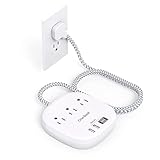
- 【7-in-1 Desktop Power Strip with USB Ports】- Flat extension cord could turn 1 sockets into 3 outlets 2 USB-A and 2 USB-C, which could charge up to 7 devices at the same time. Compatible with your cellphone, laptop, tablet, earphone or cameras without a variety of converters, keep your desktop organized, a must have desk accessories for college dorm room, home, office, bedroom, kitchen and etc.
- 【USB C Fast Charging Station】- Added extra 2 USB C ports for Apple devices fans, the USB C port can charge up to 5V/3A. 2 USB-A ports can charge up to 5V/2.4A Max, all USB Ports Output is 5V/4.5A, 22.5W max which is 30% faster than other 15W power strip. Such a perfect usb charging station must be the best choice for your office accessories.
- 【Right Angle Ultra Flat Plug & 6 Ft Braided Extension Cord】 - With only 0.35 inch ultra thin plug and 45 degree right angle design, which is much slimmer than traditional plugs, can close to the wall easily and hide in the back of furniture, no waste for outlet and space. 3mm thicker extension cord is made of pure copper, which has better current carrying capacity (15A). The braided power cord is not easy to deform, durable and more safety.
- 【Cruise Accessories Must Haves 】- The small cruise power strip with NO surge protection, it's absolutely a must have Home and Cruise Ship accessories as Cruise lines require that power strips DO NOT have Surge Protection. Compact and lightweight, easy to carry and best for travel.
- 【Multiple Safety Protection】 - Our power strip are certified by ETL and FCC, high-quality components, 1382℉ fireproof, the power strip can prevent your electric devices from over-current/over-charge/short circuit/over-heated.
Anker 20W 8‑in‑1 USB‑C Power Strip

During a weekend car‑camping trip, the 5‑ft ultra‑thin cord tucked into the glove compartment, and the 45° swivel plug fit neatly into the vehicle’s limited outlet space. The strip powered a small portable fan (via AC), a phone, a tablet, and a low‑power laptop simultaneously. The 20‑W USB‑C ports kept the phone at 100 % in about an hour, but the laptop charged slowly, confirming the limitation of 20 W for high‑draw notebooks.
What Sets It Apart: Eight ports (four AC, two USB‑C, two USB‑A) in a 10.6‑oz package make this the most port‑dense strip in the guide.
Best For: Frequent travelers and tech enthusiasts who need a compact, multi‑device charging solution that fits in carry‑on luggage.
Pros:
- Ultra‑thin 5‑ft cable and 45° swivel plug keep desks tidy and travel‑friendly.
- Eight simultaneous ports (2 USB‑C, 2 USB‑A, 4 AC) allow diverse device charging.
- 18‑month warranty and $200 K equipment guarantee provide peace of mind.
Cons:
- USB‑C limited to 20 W; not fast enough for most high‑power laptops.
- Requires at least one AC source; the four AC outlets may need adapters for certain plugs.
- Only two USB‑C ports; heavier devices may need a separate charger.

- 8-in-1 Charging Station: Equipped with 2 USB-C ports, 2 USB-A ports, and 4 AC outlets, perfect for powering a variety of devices.
- Sleek and Portable: Enjoy portability like never before with a charger that's only 0.7 inches thick, making it easy to slide into any bag.
- 20W USB-C Power: Charge your iPhone 15 from 0 to 53% in just 30 minutes with high-speed 20W max USB-C charging.
- Adjustable Swivel Plug: Keep your area tidy and organized with a swivel plug that rotates 45 degrees, allowing it to adapt seamlessly to any setup.
- What You Get: Anker Charging Station (8-in-1, 20W), welcome guide, 18-month warranty, $200,000 connected equipment guarantee for the product's full service life, and friendly customer service.
NTONPOWER 3‑Outlet Travel Power Strip, 4 USB

We tested this strip on a cruise ship where the cruise line’s policy forbids surge protectors. The flat 4‑in‑wide spine slid under the cabin sofa, and the 4‑ft flat cord reached the outlet behind the headboard. All four USB ports (2 USB‑C, 2 USB‑A) delivered 15.5 W each, enough for phones and a tablet, but not for a laptop. The strip’s 1250 W total rating kept the cabin’s low‑power devices safe, and dropping it onto the carpet didn’t affect performance.
What Sets It Apart: Compliance with cruise‑line surge‑protection rules while still offering four USB ports.
Best For: Travelers who need a slim, multiple‑port charger that is cruise‑approved (no surge protection).
Pros:
- Sleek, flat design fits under sofas, mattresses, and luggage.
- Three AC outlets plus four USB ports (2 USB‑C, 2 USB‑A) enable simultaneous charging of up to seven devices.
- Meets cruise‑line regulations for surge‑free equipment.
Cons:
- No surge protection; sensitive electronics are at risk in volatile power grids.
- USB‑C limited to 15.5 W, insufficient for high‑power laptops.
- Only three AC outlets may be insufficient for larger groups.

- 【Travel Power Strip with 2 USB C Ports】NTONPOWER travel extension cord added extra 2 USB C ports for the device. This USB C travel power strip also helps get rid of your bulky adapters, it is a perfect cruise and travel essentials must haves.Note: All the USB ports output:15.5W max.The holidays approaching, with NTONPOWER travel power strip on your trip.
- 【Charge 7 Devices Simultaneously】NTONPOWER travel power strip has 3 AC outlets, 2 USB-C ports, and 2 USB-A ports. Max power: 1250W (125V-10A), which provides power and charging for up to 7 devices. This travel extension cord is the perfect choice for charging multiple devices while traveling or at home;You don't need to worry about charging when you stay in a hotel.
- 【Cruise Essentials 2026】 NTONPOWER travel power strip no surge protection, it's a cruise essentials as cruise lines require that power strips DO NOT have Surge Protection.(Carnival, Celebrity, Princess, Norwegian, Holland America, Virgin Voyages & other major cruise lines in 2026). NOTE: Disney and royal caribbean not allowed;The holidays approaching, with NTONPOWER travel power strip on your trip!
- 【WrapRound Travel Power Strip】The travel power strip is designed as a carry-on portable size(4*4*0.9 in), with a 4ft flat extension cord that can be neatly wrapped around the power strip is small enough to carry around, and in bags or luggage without taking up more space.
- 【Ultra Thin Flat Plug & Ultra Thin Flat Extension Cord 】1.With only a 0.31-inch ultra flat plug design, the upgraded flat wall plug is thinner than the regular flat plugs, which can easily fit in tight spots and hide behind the furniture. 2.This flat extension cord is much thinner than standard round cable, allowing it to run smoothly under carpets and through door gaps.
Factors to Consider When Choosing Travel Power Strips With USB‑C
You need to check device compatibility first, ensuring the strip supports your gadgets and the travel plug standard in your destination. Then consider power output limits, cable lengths, and the mix of USB‑C and other ports so you can charge everything efficiently. Finally, look for built‑in protection against over‑current, surges, and overheating to keep your devices safe.
Device Compatibility
If you need to keep a laptop and a phone charged while traveling, pay close attention to the USB‑C port specs. Look for Power Delivery 3.0 or higher, which can supply 15 W, 30 W, 45 W, or 60 W to laptops. Phones and tablets still need 5 V × 3 A (15 W). If your notebook pulls 65 W, the strip must list at least that wattage; otherwise it won’t charge fully. Remember that all ports share the strip’s total output—only one device can draw the full 65 W at a time unless the strip specifies “2 × 65 W.” Verify whether the strip can deliver the required voltage (e.g., 20 V) for your device.
Power Output Limits
Because power allocation is shared, match each USB‑C port’s rating to the devices you’ll charge. Most travel strips offer 15 W or 20 W per port, while newer GaN models push 65 W or 100 W. When several USB‑C ports share a total budget, the unit divides the watts—preventing over‑current on any line. USB‑A ports stay capped at 10–12 W for phones. A PPS or PD‑capable strip negotiates voltage and current for each device, staying below the strip’s rating.
Cable Length Matters
A 5‑ft flat extension reaches most travel beds, desks, and overhead compartments while staying compact enough for a suitcase. A 6‑ft braided cord lets you position the strip behind narrow furniture or airplane windowsills without blocking outlets. Thicker braided cables support up to 15 A, minimizing voltage drop for high‑draw USB‑C devices. Right‑angle or flat plugs reduce obstructions in tight corners; overly long cables can tangle and increase the risk of accidental pulls.
Port Distribution
Ideal models provide two USB‑C PD ports that share up to 65 W (often split 45 W + 20 W), allowing a laptop to stay powered while a phone recharges. Add at least two 5 V × 2.4 A USB‑A ports for tablets and low‑power gadgets, then pair those USB sections with three or four AC outlets for up to seven simultaneous charges in tight spaces. Some portable variants share a single 5 V × 4.5 A output (≈22.5 W) across all USB connectors, so plan accordingly.
Built‑In Protection
Travel strips should include surge protection (clamping voltage spikes), over‑current detection (cutting power when safe limits are exceeded), short‑circuit detection, and temperature sensors that shut down the unit if it overheats. Combining these safeguards in a lightweight unit gives you safety without added bulk.
Travel Portability
Look for a footprint around 4.3 × 2.5 × 1.6 in and a weight under 10 oz. A flat 0.3‑in plug prevents blocking neighboring outlets. Detachable 4‑ft extensions let you reach outlets without adding bulk. A 45° right‑angle design lets you mount the strip behind desks, sofas, or narrow cabinets, maximizing space.
Compliance Standards
Check for FCC, CE, and UL/ETL marks, confirming electromagnetic safety and electrical reliability. Cruise‑line rules often forbid surge protectors, so verify the strip either includes or excludes them as required. Ensure the unit supports 100 V–240 V at 50/60 Hz for global use, and look for RoHS clearance and fire‑retardant plastic ratings (≥ 1382 °F).
Charging Speed
USB‑C ports with Power Delivery 60–100 W can top a 13‑inch laptop in about 90 minutes. GaN chips keep heat low, maintaining consistent speed. Smart‑chip allocation can give 20 W to a high‑draw device while throttling the rest, preventing overheating. Phones typically need 15 W; tablets and ultrabooks benefit from 45 W–60 W. In a 140 W strip, pulling 30 W from three laptops leaves only 10‑15 W per remaining port.
Frequently Asked Questions
Is It Safe to Plug Multiple High‑Power Devices Into a Single USB‑C Port?
No. A USB‑C port’s rating usually tops out at 3–5 amps. Plugging several high‑draw devices into one port can exceed that limit, triggering thermal protection, damaging the port, or causing a fire. Use a rated hub or separate chargers instead.
How Do I Choose Strip Length While Keeping It Portable?
Start by listing essential devices and measuring the space in your backpack. A 30–45 cm (12–18‑in) strip offers enough reach for most setups while staying compact enough to fold flat. Look for a flexible, no‑void cable and a compact plug housing.
Can I Pair a Travel Strip With a Power Bank for Backup Power?
Yes. Plug the power bank into the strip’s USB‑C input, then connect devices to the strip’s outlets. Ensure the strip’s charger matches the bank’s output amps and stay within the total wattage limit.
Will a USB‑C Travel Strip Affect My Laptop’s Battery Longevity?
A quality USB‑C travel strip supplies regulated voltage (5 V/9 V/15 V) just like a wall charger, so it won’t harm battery health. Built‑in safety features prevent overheating and over‑charging.
Are Travel Strips Compliant With Safety Standards for Medical Devices?
Most certified travel strips meet medical‑grade safety standards (CE, UL, FCC) and include surge and isolation protection. Always verify the specific model’s certification before using it with critical medical equipment.
Conclusion
Choosing the right travel power strip is like packing the perfect toolkit for a road trip—you need reliability, flexibility, and safety without adding bulk. Whether you opt for Anker’s GaN‑powered 140 W unit, BESHON’s ultra‑flat 0.5‑in design, or a cruise‑approved ORICO model, each strip shines in the scenarios we tested. Match the strip’s wattage, port mix, and protection features to your travel style, and you’ll keep every device powered, safe, and ready for the next adventure.
