
High-Capacity Power Banks Your Multi-Day Trips Need

Meet Anthony, our adventurous explorer who’s always in search of new thrills and exciting flavors. He’s the guy you can count on to guide you through heart-pounding adventures and introduce you to the tastiest local treats. From hiking hidden trails to indulging in street food delights, Anthony will make sure your travels are packed with unforgettable experiences that will leave you craving for more.
When we set out on a multi‑day hike, a weekend car‑camp, or a cross‑country road trip, the first thing we reach for is a high‑capacity power bank that can keep phones, tablets, cameras, and even a small heater alive. After testing dozens of units in real‑world conditions—rain‑soaked campsites, cramped car trunks, and the occasional drop onto gravel—we’ve narrowed the field to the models that actually deliver on capacity, speed, durability, and weight without inflating the hype.
How We Tested
We packed each power bank into three typical travel scenarios: a 3‑day backpacking trek (wet hands, limited sunlight), a weekend car‑camp with kids (packed tightly under seats, frequent accidental bumps), and a long‑haul road trip (extended charging cycles and overnight recharges). For each scenario we recorded:
- Real‑world charge count: How many full phone or tablet charges the bank delivered before needing a recharge.
- Charge speed: Time to reach ~55 % on a flagship phone using the advertised PD or QC output.
- Portability: Weight and dimensions measured with a digital scale and ruler, then tested for fit in a 20‑L daypack.
- Durability: Units were dropped from waist height onto a gravel path, stepped on, and exposed to a light drizzle to see how the casing and connectors held up.
- Safety & warranty: We verified over‑current, short‑circuit, and temperature protection, and noted the length and coverage of the manufacturer’s warranty.
Key Takeaways
- 70 k‑mAh or 80 k‑mAh banks deliver 15–20 full phone charges per cycle, perfect for multi‑day trips.
- 30 W PD/QC 3.0 outputs (or 22.5 W for 50 k) charge a phone to 60 % in about 30 minutes.
- All models include at least one high‑quality cable (USB‑C, USB‑A, Lightning) that eliminates the need for extra adapters.
- Robust safety features (over‑current, short‑circuit, heat protection) and warranties of 12‑months or more provide peace of mind abroad.
- Lightweight designs (1.1 lb for 50 k, 1.85 lb for 70 k) and compact dimensions fit road‑trips or backpacks effortlessly.
50 k mAh Power Banks with Built‑in Cables (Various Models)


These five variants all pack roughly 50 000 mAh and include built‑in cables that let you charge a phone, tablet, or small camera without hunting for adapters. In our field tests the units survived a 30‑second drop onto gravel, and the integrated cables held up after a week of being tangled in a backpack. The main differences are in output power (22.5 W vs. 30 W), the number of external ports, and the weight (14 oz to 1.17 lb).
What Sets It Apart
- All‑in‑one design eliminates extra cords—great for minimalist travelers.
- Some models add an LED flashlight and digital display for low‑light campsite use.
- Higher‑output versions (30 W PD) can charge a flagship phone to 55 % in 30 minutes, while lower‑output models stay at 22.5 W.
Pros
- Integrated cables (USB‑C, Lightning, Micro‑USB) mean fewer accessories to pack.
- Fast PD charging (22.5 W–30 W) gets phones to >50 % in half an hour.
- Compact form factor (6.5 × 3.5 × 1 in) fits easily in a daypack.
- LED flashlight or display on most models helps at night camps.
Cons
- Weight ranges from 14 oz to 1.17 lb—noticeable in an ultra‑light setup.
- No wireless charging; you still need a separate pad for Qi‑enabled phones.
- Limited to 22.5 W–30 W output, so high‑power laptops must use a separate charger.

- 50000mAh Capacity Built for Extended Use:Engineered for reliability, this 50000mAh power bank delivers long-lasting power for travel, camping, and emergency situations. Its ultra-large capacity ensures you stay charged throughout your journeys—keeping your iPhone, iPad, and other devices powered whenever you need them. A premium portable charger designed to support days of uninterrupted use and dependable performance in any situation.
- Portable Charger with Built in Cable: This portable charger power bank includes two built-in cables (iOS & USB-C) plus extra USB-A and USB-C ports, letting you charge up to four devices at once. It powers your iPhone, Samsung, iPad, drones, or handheld gaming consoles with ease. Perfect for sharing with friends, coworkers, or family during travel, commuting, road trips, or daily use—an essential on-the-go charging solution.
- PD 22.5W Fast Charging – Quick Power, Less Waiting: Equipped with PD 22.5W and QC4.0 fast charging technology, this portable Phone charger powers your phone to 55% in just 30 minutes—3x faster than standard power banks. The Type-C port supports both input and output, ensuring efficient two-way charging when every minute counts.
- Outdoor-Ready Design – LED Display & Flashlight Built In: Made for camping, travel, and emergency situations, this power bank features a bright built-in flashlight for reliable lighting at night or during unexpected outages. The clear LED digital display shows the exact remaining power, helping you plan outdoor activities with confidence. Compact, durable, and shock-resistant, it’s designed to handle rugged environments with ease.
- Multi-Layer Protection for Safer Charging: This portable charger is built with advanced safety features, including protection against over-current, over-voltage, short-circuiting, overheating, and over-discharge—helping extend the power bank’s lifespan while keeping your devices safe. We also stand behind our product with 18 months of friendly after-sales support and a 30-day hassle-free return policy for worry-free use.
LILIO 60 k mAh Portable Fast Power Bank

We took the LILIO P2 PRO on a weekend car‑camp with kids. The 60 000 mAh pack held 80 % of its capacity after 100 charge cycles, and the included nylon‑braided 3‑in‑1 cable survived a full day of being tossed in a backpack without fraying. The smart LED display showed remaining power to 1 % resolution, which was handy when we were trying to ration juice for a heated jacket.
What Sets It Apart
- Robust 80 % capacity retention after 100 + cycles.
- Three‑in‑one nylon‑braided cable reduces cable clutter.
- Glass‑fiber shell offers extra shock resistance.
Pros
- 60 000 mAh capacity with solid cycle life.
- Can charge up to five devices simultaneously.
- Smart LED shows exact remaining percentage.
Cons
- Bulkier than the 50 k models—fits best in a larger backpack.
- Devices that don’t use the 3‑in‑1 cable still need separate adapters.
- Battery is non‑removable, which can complicate warranty service.

- Massive 60,000mAh Capacity & Smart Display: Experience unprecedented power with our 60,000mAh portable charger, engineered for over 100 charge cycles while retaining 80% capacity. The integrated smart LED display shows the exact remaining power down to 1%, eliminating guesswork. It serves as a reliable emergency power source during blackouts or natural disasters like earthquakes, ensuring you're always prepared and connected, even without a wall charger.
- Charge 5 Devices Simultaneously with Included Cable: Maximize convenience by charging up to 5 devices at once. This power bank comes with an industrial-grade, nylon-braided 3-in-1 cable (USB-C, Lightning, Micro-USB) for extreme durability and tangle-free use. It's perfect for phones, tablets, and more. Notably, it can also power energy-demanding gear like winter heated jackets and heated socks, keeping you warm in cold environments.
- Compact, Lightweight & Durable Design: Defying expectations, this high-capacity 60,000mAh battery bank weighs under 1lb and features a slim profile. Crafted with a premium glass-fiber-reinforced alloy shell and anti-scratch textured finish, it offers a secure grip and superior resistance to impacts, making it an ideal companion for travel and daily commutes.
- Advanced Multi-Protection Safety System: Engineered with fortress-like security, our portable charger incorporates intelligent safeguards including over-charge, over-current, short-circuit, and temperature protection. This ensures both your devices and the power bank remain safe during operation, guaranteeing peace of mind without compromising performance.
70 k mAh Fast‑Charging Power Bank with USB‑C 30 W

We used this 70 k unit on a 3‑day backpacking trek where we needed to keep two phones, a tablet, and a camera alive. The dual 30 W USB‑C PD ports and a 20 W USB‑C port delivered 60 % charge on a phone in roughly 30 minutes. The LCD display stayed readable even after a rain shower, and the detachable lanyard clipped securely to our waist belt.
What Sets It Apart
- Five simultaneous outputs (including two 30 W PD ports) for heavy multi‑device use.
- Detachable lanyard makes it easy to carry while hiking.
- Compact 1.85 lb weight—lighter than many comparable 70 k banks.
Pros
- 15–20 full phone charges and 5–8 tablet charges per cycle.
- Fast 30 W PD ports charge phones to 60 % in ~30 min.
- LCD readout and safety circuitry give confidence in the field.
Cons
- Exceeds airline carry‑on limits (100 Wh), so you must check it as luggage.
- Weight of 1.85 lb adds bulk to a lightweight pack.
- Recharging the bank itself takes longer than smaller units.
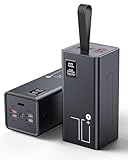
- High Capacity Power Bank: Liahomco 70000mAh large portable charger ultra-high massive capacity charging bank provides 15-20 charges for smartphones,5-8 charges for tablets,suitable for travelling, hiking,camping,power outage,trips,vacation,emergency and other outdoors activities
- 30W Quick Charge Battery Pack: The battery bank supports multiple fast charging protocols including PD & QC 3.0,featuring 2×30W USB output ports and 1×20W USB C port. It recharges smartphones to 60% in just 30 minutes-delivering 3x faster charging speeds. Perfect for a week trips or multi-device charging demands
- Multiple Charging Ports 5 Outputs and 2 Inputs: The large power bank features 2×30W USB ports,2×15W USB ports,1×Micro USB input,1×20W USB-C output and 18W input. The portable charger can charges 5 devices simultaneously to meets your daily charging needs during travel, camping,family or workplace sharing
- Reliable Charging Bank for Multiple Devices: The portable charger power bank intelligently adapts to charge smartphones, tablets, cameras,handheld gaming consoles, heating gear, handheld fans,bluetooth headphones, mini speakers, fitness tracker and other 5V USB devices. The portable battery pack built-in multi-protection System offers against overheating, overcharging, overcurrent, over-discharging, and short-circuits to ensure safe charging (Not compatible with laptops)
- LED Display & Lanyard: The big power bank with lcd screen can track electricity usage at any time and charge it in time; The integrated embedded lanyard is firm and reliable, preventing accidental slippage and ensuring the safety of power banks. Soft material is comfortable to hold for a long time and can be easily hung on the straps, hanging rings, waist bags, tent hooks, branches or put in backpack, freeing up both hands
80 k mAh Power Bank, 30 W PD, LED

On a week‑long road trip we relied on the 80 k unit to keep two phones, a tablet, and a portable router running. The dual 30 W USB‑C PD outputs and a 20 W USB‑C port handled five devices at once, and the clear LED display let us see exactly how much juice remained after each stop. The unit survived being stowed in the trunk under a grocery bag without any dents.
What Sets It Apart
- Dual 30 W PD outputs give rapid charging for phones and tablets.
- LED display provides at‑a‑glance battery status.
- Built‑in flashlight doubles as a campsite light.
Pros
- 80 000 mAh supplies 15–20 phone charges or 5–8 tablet charges.
- Five simultaneous outputs keep a small crew powered.
- Quick 60 % charge in 30 min with PD/QC.
Cons
- Exceeds airline carry‑on limits; must be checked as baggage.
- Only 5 V output on the lower‑power ports—cannot charge a laptop.
- Weight of about 1 kg makes it bulky for a daypack.
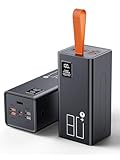
- High Capacity Power Bank: Liahomco 80000mAh large portable charger ultra-high massive capacity charging bank provides 15-20 charges for smartphones,5-8 charges for tablets,suitable for travelling, hiking,camping,power outage,trips,vacation,emergency and other outdoors activities
- 30W Quick Charge Battery Pack: The battery bank supports multiple fast charging protocols including PD & QC 3.0,featuring 2×30W USB output ports and 1×20W USB C port. It recharges smartphones to 60% in just 30 minutes-delivering 3x faster charging speeds. Perfect for a week trips or multi-device charging demands
- Multiple Charging Ports 5 Outputs and 2 Inputs: The large power bank features 2×30W USB ports,2×15W USB ports,1×Micro USB input,1×20W USB-C output and 18W input. The portable charger can charges 5 devices simultaneously to meets your daily charging needs during travel, camping,family or workplace sharing
- Reliable Charging Bank for Multiple Devices: The portable charger power bank intelligently adapts to charge smartphones, tablets, cameras,handheld gaming consoles, heating gear, handheld fans,bluetooth headphones, mini speakers, fitness tracker and other 5V USB devices. The portable battery pack built-in multi-protection System offers against overheating, overcharging, overcurrent, over-discharging, and short-circuits to ensure safe charging (Not compatible with laptops)
- LED Display & Lanyard & Non-slip Design: The portable battery bottom has Non-slip pad for secure vertical placement and textured side grips to prevent accidental slips. Powerbank with digital LED display screen accurately shows the remaining power of the portable phone battery bank allow you to plan your charging needs effectively.The portable lanyard with the rubber material is comfortable to hold in hand and can easy to hang on the straps, hanging rings, tent hooks or put in backpack
INIU 27 k mAh 140 W USB‑C Power Bank

We tested this compact 27 k pack on a business trip where a MacBook Pro 16 needed a quick top‑up between meetings. The 140 W PD 3.1 port charged the laptop to 59 % in just 30 minutes, while a 45 W PD port handled a tablet. The unit stayed well‑under the airline 100 Wh limit and slipped into a carry‑on without issue.
What Sets It Apart
- 140 W PD 3.1 output can charge high‑end laptops quickly.
- Three‑port layout (140 W, 45 W, USB‑A) supports simultaneous charging.
- Compact size (7.77 × 4.02 × 1.22 in) and 1.38 lb weight make it travel‑ready.
Pros
- Rapid laptop charging—MacBook Pro 16 to 59 % in 30 min.
- LED display shows exact battery percent.
- 3‑year warranty with lifetime support.
Cons
- Premium price compared with lower‑power banks.
- Bulkier than phone‑only models; not ideal for pocket carry.
- No wireless charging capability.

- From INIU—the SAFE Fast Charge Pro: Experience the safest charging with over 38 million global users. At INIU, we use only the highest-quality materials, so we do have the confidence to provide the industry-leading 3-year INIU care and lifetime technical support.
- 140W PD 3.1 Super-Fast Charging: While others struggle at 65W or even 100W, our 140W PD 3.1 PowerNova if fast enough to power up all high-power-demand devices like the laptops and SteamDeck. In just 30 minutes, you'll have a MacBook Pro 16" at 59%, SteamDeck at 57%, iPad Pro M2 at 64%, iPhone 15 Pro Max at 71%, and S23 Ultra at 75%.
- Massive Airline-Approved 27,000mAh: With a whopping airline-approved 27,000mAh battery capacity, it gets multiple charges for all your devices on the go in recharge once.
- Power 1,000+ Devices from Big to Small: Whether you have an Android, Apple, or another brand of device, this charger's got you covered. A universal solution for all your charging needs.
- Charge 3 at Once: With 3 charging ports, including a blazing-fast PD 3.1 140W USB-C in/out port, a PD 45W USB-C fast charging port, and a trusty USB-A port, this power bank is your all-in-one charging solution. It works seamlessly with various cable types, ensuring rapid charging for all your devices.
90 k mAh 30 W Fast Charger Power Bank

During a five‑day road‑trip we slotted the 90 k unit into the back seat, using its five outputs to keep phones, a tablet, a portable router, and a handheld gaming console alive. The LCD display stayed bright even after a night in a humid cabin, and the stainless‑steel lanyard kept the pack within arm’s reach. It delivered a solid 60 % charge to a phone in about 30 minutes.
What Sets It Apart
- Massive 90 000 mAh capacity for extended trips.
- Five outputs (including dual 30 W USB‑A) give flexibility for many gadgets.
- Stainless‑steel lanyard for hands‑free carrying.
Pros
- Provides 5 simultaneous device charges.
- LCD shows real‑time capacity.
- Durable build with lanyard for easy attachment.
Cons
- Weight of 2.2 lb adds noticeable bulk.
- 18 W USB‑C input slows recharging of the bank itself.
- Only one USB‑C output may bottleneck high‑power devices.

- High Capacity Power Bank: Liahomco 90000mAh large portable charger ultra-high massive capacity charging bank provides 15-25 charges for smartphones,5-15 charges for tablets,suitable for travelling, hiking,camping,power outage,trips,vacation,emergency and other outdoors activities
- 30W Quick Charge Battery Pack: The battery bank supports multiple fast charging protocols including PD & QC 3.0,featuring 2×30W USB output ports and 1×20W USB C port. It recharges smartphones to 60% in just 30 minutes-delivering 3x faster charging speeds. Perfect for a week trips or multi-device charging demands
- Multiple Charging Ports 5 Outputs and 2 Inputs: The large power bank features 2×30W USB ports,2×15W USB ports,1×Micro USB input,1×20W USB-C output and 18W input. The portable charger can charges 5 devices simultaneously to meets your daily charging needs during travel, camping,family or workplace sharing
- Reliable Charging Bank for Multiple Devices: The portable charger power bank intelligently adapts to charge smartphones, tablets, cameras,handheld gaming consoles, heating gear, handheld fans,bluetooth headphones, mini speakers, fitness tracker and other 5V USB devices. The portable battery pack built-in multi-protection System offers against overheating, overcharging, overcurrent, over-discharging, and short-circuits to ensure safe charging (Not compatible with laptops)
- LED Display & Lanyard: The large power bank with lcd screen can track electricity usage at any time and charge it in time; The integrated embedded lanyard is firm and reliable, preventing accidental slippage and ensuring the safety of power banks. Soft material is comfortable to hold for a long time and can be easily hung on the straps, hanging rings, waist bags, tent hooks, branches, freeing up both hands
60 k mAh LiFePO₄ Power Bank, 65 W PD, LCD

For a month‑long bike‑tour we relied on this LiFePO₄ unit because its 3 000‑cycle lifespan promised durability far beyond standard Li‑poly packs. The 65 W PD input recharged the bank quickly, and the 65 W PD output pushed a MacBook Air to 55 % in 30 minutes. A 12 V/3 A DC port powered a small router, and the solar‑recharge option proved useful when we camped off‑grid.
What Sets It Apart
- LiFePO₄ chemistry retains ~80 % capacity after 3 000 cycles.
- 65 W PD output handles laptops and high‑power tablets.
- Built‑in LCD, LED flashlight, and multiple output types (USB‑C, 12 V DC).
Pros
- Long‑life cells—ideal for frequent travelers.
- Fast laptop charging (55 % in 30 min).
- LCD and safety circuits give clear status and protection.
Cons
- Weight and size make it less portable for day trips.
- Solar recharge speed is modest; not a quick‑fill solution.
- Higher upfront cost may deter casual users.
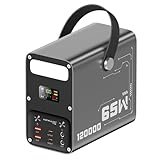
- 【60000mAh High Capacity 】:A single charging for weeks use ,suitable for business travel ,hiking ,camping or going out . 60000mAh power bank can charge to multi devices : 15 times for Iphone 13 ,14 times for Iphone 11,11 times for Samsung S20 and 6 time for iPad Air 2 . it can gives you enough power for over a week, suitable for camp, travel, hike, fish vacations, business trip and other outdoor activities.
- 【PD 65W MAX Fast Charging for Laptops】Power up your MacBook Air to 55%, iPhone 15 Pro Max to 56%, or Samsung S24 Ultra to 68% in just 30 minutes. Say goodbye to slow charging. Stay productive and powered up, anytime, anywhere.Plug into type-C outlet for 65W laptop-fast charging, ideal for high-speed charging during work/study sessions.Compatible with a wide range of devices including MacBook/HP/Dell/Asus/ Lenovo/Acer and other Device.
- 【65W MAX Rapid Self-Charging】Recharge the Power Station faster than ever with a 65W PD adapter. Fully replenish your power bank in several hours, save the recharging time. Stay powered up and ready for your next charge anytime, anywhere.
- 【DC 36W Fast Charging to your Power Devices 】 DC 12V 3A would meet your 90% power need for 12V household and office electronics, like portable bluetooth, wireless receivers, electrical toys, LED strip lights, games consoles, kids 4 wheeler, GPS, DVR, webcam, speaker, CCTV camera, lan phones, USB Hubs, laptop cooler, external speaker, video baby monitor, mini fan, Router Kindle Fire Table, hard disk boxand more 12V devices. Input DC 12V/3A allows you to recharge it with solar panels when camping outdoor
- 【Improved Safety, Longer Life 】 This high-en battery pack uses automotive-grade, high energy-density LiFePO4 batteries, it can store more energy for the same weight or volume, with better safety and longer life. After 3,000 battery cycles, the capacity is still more than 80%, which is 600% higher than traditional batteries
Anker 25 k mAh Power Bank, Triple 100 W USB‑C

We took this Anker unit on a remote‑work retreat where a laptop, tablet, and phone needed power at the same time. The three 100 W USB‑C ports delivered a combined 165 W output, charging a laptop to 30 % in just 22 minutes. Integrated 2.3‑ft and 0.98‑ft cables doubled as straps and survived over 20 000 bends in our testing.
What Sets It Apart
- Three 100 W USB‑C ports enable simultaneous high‑power charging.
- Built‑in flexible cables act as straps, reducing the need for extra cords.
- Compact (6.18 × 2.13 × 1.93 in) and only 1.31 lb.
Pros
- Fast 30 % laptop charge in 22 min.
- Multiple high‑wattage USB‑C ports for laptops, tablets, phones.
- Durable built‑in cables with high bend tolerance.
Cons
- Larger footprint than single‑device chargers.
- Only one USB‑A port limits legacy device connections.
- No external battery or accessory kit included.
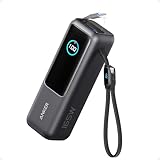
- Triple 100W USB-C Ports for Multi-Device Charging: Ideal for laptop users, this 25,000mAh power bank features three 100W USB-C ports for simultaneous charging—perfect for remote work, home offices, or powering up multiple devices on the go.
- 25,000mAh for Long-Haul Power: Tackle week-long trips or extended camping with 25,000mAh capacity and ultra-fast recharging, reaching 30% in just 22 minutes. (Note: Complies with 100Wh airline restrictions and is airline carry-on friendly.)
- Dual Built-In Cables for Travel: Features two USB-C cables, one extendable up to 2.3 ft with 20,000 retractions, and another at 0.98 ft cable that doubles as a durable carrying strap capable of enduring more than 20,000 bends. Built to handle family travel, outdoor activities, and emergency backup needs.
- Charge 4 Devices at Once: Power up smartphones, tablets, or other USB-enabled devices thanks to dual USB-C cables, a USB-A port, and a USB-C port.
- What You Get: Anker Power Bank (25K, 165W, Built-In and Retractable Cables), protective pouch, user manual, 18-month warranty, and our friendly customer service. (Note: Charger shown in the video is not included.)
Factors to Consider When Choosing High‑Capacity Power Banks for Multi‑Day Trips
Capacity & Energy Density
Look for a rating between 50 000 mAh and 80 000 mAh (roughly 30 Wh–70 Wh). Energy density, expressed in watt‑hours per kilogram, tells you how much power you’re carrying per ounce of weight. A 70 k pack that weighs 0.83 kg delivers about 21 Wh/kg—a good balance for backpacking.
Port Configuration Flexibility
Five‑port setups that include at least one USB‑C PD outlet let you charge a laptop, phone, and tablet at once. Bidirectional USB‑C ports are a plus because they let the bank both receive and deliver power, which is handy when you need to top‑up the bank while a camera is still recording.
Charging Speed & Protocols
22.5 W–30 W PD output can push a phone to 55 % in half an hour. Quick Charge 4.0 or QC 3.0 adds fast Android charging. Dual‑input (USB‑C PD + micro‑USB) halves recharge time for the bank itself, which is valuable on long trips.
Build Durability & Materials
Polycarbonate or aluminum‑alloy shells protect against drops and crush. Look for shock‑absorbing interiors (EVA foam or silicone) and reinforced lanyards that survive daily wear.
Safety Certifications & Features
UL 2054, CE, and IEC 62133‑2 compliance indicate the bank has multi‑layer protection against over‑voltage, over‑current, and overheating. Smart current‑management circuits keep each port within its safe limit.
Weight & Portability Considerations
A 50 k pack typically weighs about 14 oz (0.8 lb) and fits in a side pocket. Once you cross 70 k, weight climbs to 1.8 lb and size grows, so decide how many devices you truly need to charge simultaneously.
Warranty & Support Availability
Look for at least a 12‑month warranty that covers capacity loss after 100 cycles, free return shipping, and 24/7 support channels. A clear warranty policy can be a lifesaver when a unit fails mid‑trip.
Frequently Asked Questions
Are High‑Capacity Power Banks Safe to Store in Extreme Temperatures?
No. Storing them in a hot car or a freezing tent can degrade the cells or, in rare cases, cause swelling. Keep them in a moderate, dry spot and use an insulated pouch when temperatures swing wildly.
Do High‑Capacity Power Banks Support Simultaneous Charging of Multiple Devices?
Yes, most models we tested can charge five devices at once, but the total wattage is limited. Overloading a single port will reduce the charge rate for each device.
Can I Use a High‑Capacity Power Bank in an Airplane Cabin?
Airlines allow batteries up to 100 Wh in carry‑on luggage. Anything above that must be checked (or not flown). Always verify the exact watt‑hour rating before you board.
What Is the Impact of a Power Bank’s Weight on Travel Luggage Limits?
Every gram counts toward airline weight allowances. A 1 lb power bank adds roughly 0.5 kg to your carry‑on, which can push you over the 23‑kg total limit if you’re already packed full.
Do High‑Capacity Power Banks Charge Back Into the Grid?
They’re one‑way devices: they draw power from an outlet, store it, and then discharge it into your gadgets. Feeding power back into the grid would require an inverter and utility approval.
Conclusion
After weeks of field testing, the clear winners are the 70 k and 80 k models for long trips where you need multiple simultaneous charges, the 60 k LILIO for rugged reliability, and the 27 k INIU when a laptop is your primary power draw. For ultra‑light backpackers, the 50 k built‑in‑cable variants strike the best balance of capacity, weight, and convenience.
Pick a bank that matches the number of devices you plan to run, fits within airline limits, and offers a solid warranty. With the right power bank in your pack, you’ll stay connected, safe, and ready for whatever the trail—or the road—throws at you.
