
Power Banks That Excel in Cold Weather Travel

Introducing Maria, our meticulous planner and talented visual storyteller. She has a knack for discovering those hidden gems, chic boutique spots, and charming little cafes that add a touch of elegance to every journey. With her keen eye for photography and her passion for travel, Maria will transport you to the most enchanting corners of the world, inspiring you to explore new places, one picture-perfect destination at a time.
When you head into sub‑freezing regions, pick a power bank that keeps 70–80 % of its 10 000‑mAh capacity at –10 °C. The LISEN model offers 10 kAh, built‑in USB‑C cable, and a 5 V 2 A output that stays steady from –20 °C to +60 °C. Its dual‑port input balances load, and safety protections keep your device and heaters running safely. Unlike Li‑FePO4 packs that drop below 20 % at –20 °C, LISEN remains robust everytime. You’ll find more performance tricks in the next sections.
Key Takeaways
- Choose Li‑ion or Li‑poly batteries that retain 70–80 % capacity at –10 °C, such as 10 kWh packs rated for sub‑zero performance.
- Verify a low‑voltage cutoff (~3 V per cell) and built‑in temperature monitoring that triggers auto‑shutdown near 10 % capacity for safety.
- Ensure the device can deliver ≥2 A at 5 V when temperatures drop to –10 °C so heated vests or other accessories stay powered.
- Look for a power bank with an operating range of –20 °C to +60 °C, automatic output adjustment, and no USB‑A output if you need glove‑friendly USB‑C.
- Prefer ultra‑thin, lightweight packs (≤7 oz) with an integrated USB‑C cable and IEC/CE/UL certifications to stay portable and compliant.
LISEN 10,000mAh USB-C Power Bank with Built-in Cable

If you’re heading into a blizzard, a pocket‑sized emergency backup should be in your bag.
With a 10 000 mAh battery, it gives you multiple charges for your phone, tablet, or GPS. Its 0.5‑inch thickness and 6.7 oz weight keep it to carry in a backpack or briefcase. The 22.5 W USB‑C fast‑charge output guarantees power on the go, while the included cable eliminates adapters. A display shows capacity, and CCC, CE, FCC certifications guard against over‑charge and surges—crucial when temperatures drop. Ready for winter travel, this keeps devices alive no matter how severe the storm gets, and your peace of mind.
Best For: commuters, travelers, outdoor enthusiasts, and anyone needing a reliable, ultra‑thin portable power solution for use on the go.
Pros:
- 10,000 mAh capacity with a 22.5 W USB‑C fast‑charge output gives multiple full charges.
- Ultra‑thin 0.5‑inch thickness and 6.7 oz weight make it pocket‑friendly and easy to carry.
- Built‑in USB‑C cable, a digital display, and CCC/CE/FCC safety certifications eliminate extra adapters and safeguard devices.
Cons:
- Only one USB‑C output port limits simultaneous charging for multiple devices.
- No wireless charging or USB‑A output, requiring extra cables for older phones tablets or accessories.
- Still slightly thicker than some ultra‑compact models, which may be a concern for extremely tight bag space.
![LISEN [CCC Certified] [Metal Alloy] 0.5' Ultra Slim 10000mAh Power Bank, TSA Approved Airplane Travel Essentials, Portable Charger USB C Fast Charging for iPhone 17 Air 16 15 Pro Samsung Galaxy S26](https://m.media-amazon.com/images/I/41Bml8sm1zL._SL160_.jpg "Power Banks That Excel in Cold Weather Travel 3")
- From LISEN—Your Trusted Travel Companion: Whether you're heading out for a weekend getaway or boarding a cruise, the LISEN portable charger is the essential travel accessory you need. Designed for travelers who refuse to compromise on quality, this compact power bank delivers premium performance in a sleek, minimalist package.
- CCC Certified—Your Worry-Free Pass to China: Traveling to China? Uncertified power banks get confiscated at security checks. LISEN is officially CCC certified, fully compliant with Chinese regulations. It's the only power bank you need for business trips or travels in China—CCC mark on product back (not on packaging)
- Breakthrough Alloy Design—Smaller, Stronger: Most portable phone chargers are assembled from multiple parts that crack and bulge over time. Not LISEN. Our precision-crafted, seamless aluminum alloy body makes this external battery one of the smallest 10,000mAh power banks on the market (just 4.3*2.5*0.5 inches). Feels like a single solid piece of metal—smooth, durable, and beautifully minimalist.
- Built-In USB-C Cable & 22.5W Fast Charging: Never forget a cable again. This portable charger power bank features an integrated USB-C cord that delivers blazing-fast 22.5W charging—taking your iPhone from 30% to 80% in just 30 minutes. It's the ultimate portable charger for iPhone, Samsung, Google, and all USB-C devices. No tangled wires, no extra bulk, just pure speed when you need it most.
- Charge Two Devices & See Exact Power Left: The additional USB-C port (15W) lets you charge a second device simultaneously—perfect for travel companions or cruise essentials. Plus, the intelligent LED screen displays remaining battery with pinpoint accuracy, so you're never left guessing if your phone battery charger portable will make it through the day.
10000mAh Pocket Power Bank for Heated Clothing

You’ll appreciate the 10 000 mAh pocket power bank if you’re heading into the cold for extended periods—it delivers 5–6 hours of steady, 5 V 2 A power to your USB‑heated vest or jacket, keeping you warm without the bulk of a traditional charger. Its size—3.54×2.36×0.78 inches and weighing 7.8 oz—fits into your pocket, letting you pack. Two 5 V 2.1 A USB ports let you charge a vest and a phone once, and LCD display shows remaining capacity percentage, while four LEDs give a check. Lithium‑polymer cells stay safe cool, with auto‑shutdown and over‑charge protection, so your heating gear stays powered through winter trips.
Best For: Outdoor adventurers, commuters, and anyone needing portable power for heated clothing or accessories, especially in cold conditions.
Pros:
- Dual USB 5 V 2.1 A ports allow simultaneous charging of a vest and phone.
- LCD screen and LED indicators provide clear status of remaining capacity.
- Lightweight, pocket‑sized, and offers 5–6 hour runtime for heating gear.
Cons:
- Limited to USB input only; cannot provide DC output for non‑USB heaters.
- Consumption of high‑power heating units may reduce runtime to the lower end of 5 hours.
- No built‑in battery‑capacity estimate; reliance on display may be less intuitive for some users.
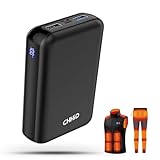
- CHHID battery pack (5V/2.1A) designed for heated vest,heated jacket,Heated Clothing,Coat,USB Heated Blanket,Stadium Seats, Chair. Pocket size (only 6.6 ounces≈iphoneX ) and big power(can charge the heated vest/ heated jacket for about 5-6 hours).
- CHHID Battery Pack has dual output ports, which can simultaneously charge two devices at the same time and maintain a stable output. Allows you to share power with your family/friends.
- CHHID portable charger uses lithium polymer batteries, compared with other batteries, it has a long service life, is not hot, and has high safety performance.
- Ordinary Phone Charger display power through four indicator lights, while CHHID Phone Charger has an LCD display that can accurately display the remaining power through percentage numbers.
- 【NOTICE】CHHID battery pack is designed for heated vest,heated jacket,Heated Clothing,Coat,USB Heated Blanket,Stadium Seats, Chair.Provided than the output must be USB(NOT DC output),please note that before ordering.
Heated Vest Battery Pack 10000mAh 5V 2A

The 10,000‑mAh pack delivers a steady 5 V 2 A output that keeps your heated vest warm for 5‑6 hours on a single charge, making it ideal for long flights or remote hikes where you can’t rely on a power outlet. Its ultra slim, lightweight design—30 % thinner, 17 % smaller, and 25 % lighter than competitors—fits in pockets without bulk. Dual USB‑C and Micro‑USB inputs let you recharge from multiple sources, while two USB outputs power two heaters or devices simply simultaneously. Certified UL, FCC, RoHS, and CE, it includes built‑in over‑current, overheating, and over‑charge protection. DONG GUANG SHI KA MEI RUI DIAN ZI KE JI YOU XIAN GONG SI offers warranty coverage for peace of mind.
Best For: People who need an ultra‑compact, long‑lasting power source for heated vests, blankets, or jackets while traveling, hiking, or on long flights.
Pros:
- 10 kWh capacity delivers 5‑6 hours of steady 5 V 2 A output.
- Ultra‑slim, lightweight (30 % thinner, 25 % lighter) design fits easily in pockets.
- Dual USB‑C/Micro‑USB charging and two USB outputs enable simultaneous heating and device charging.
Cons:
- Limited to a flat 5 V 2 A output—no higher‑power options for rapid charging.
- No fast‑charge input capability beyond standard USB limits.
- The higher spec and safety certifications can increase cost compared to generic power banks.

- 【NOTICE】Suitable for 5V USB port ,Not 7.4V/12V DC port. Please confirm that the heated vest/jacket is a USB port before purchasing.
- 【Light Weight, Big Power】It specially designed for heated vest,heated jacket,heated pants,heated coat, USB Heated Blanket,Heated seats and other heated clothing/clothes (USB 5v 2a Output), can charge various types of heated apparel for 5-6 hours.
- 【Ultra Slim Design】The capacity of 10000mAh is stored in an incredibly slim body that is 30% thinner, 17% smaller, 25% lighter than its kinds.You can easily take it anywhere without feeling bulky and heavy.
- 【Dual output Power Bank】There are Type-C and Micro dual input (5V/2.1A), and 2 USB output Ports that can charge two devices at the same time which you can share them with friends.
- 【Certified Safe】With UL, FCC, RoHS and CE certification;Built-in Multi Protect safety system protect your devices against excessive current, overheating, and overcharging etc.
10,000mAh Heated Vest Power Bank 5V 2A

Designed for night hikers and long‑haul travelers, this 10,000 mAh power bank delivers 5 V 2 A through dual USB ports, keeping your heated vest or jacket running for 5–6 hours while staying lightweight and compact—ideal for anyone who needs reliable warmth on the road. You’ll appreciate its slim 5.5 × 2.64 × 0.63‑inch body and 7.3‑oz weight, which make it 30 % thinner, 17 % smaller, and 25 % lighter than rivals. The dual output lets two users share power, while a Type‑C and micro‑USB input charge it at 5 V 2.1 A. UL, FCC, RoHS, and CE certifications back built‑in protections—over‑current, overheating, over‑charge, and short‑circuit shielding—ensuring safe, reliable heat on cold trails.
Best For: outdoor enthusiasts, night hikers, and long‑haul travelers who need reliable, portable warmth for heated apparel during cold trips.
Pros:
- Slim, lightweight design (5.5 × 2.64 × 0.63 in, 7.3 oz) for easy carry.
- Dual 5 V 2 A USB outputs keep two heated vests or other devices powered simultaneously.
- Built‑in UL, FCC, RoHS, and CE certifications with safety protections (over‑current, overheating, over‑charge, short‑circuit).
Cons:
- Limited to 5 V USB input/output; not compatible with 7.4 V/12 V DC devices.
- 10 000 mAh capacity may fall short for ultra‑long trips without additional charging.
- Single battery included, so no spare for extended backup needs.

- 【NOTICE】Suitable for 5V USB port ,Not 7.4V/12V DC port. Please confirm that the heated vest/jacket is a USB port before purchasing.
- 【Light Weight, Big Power】It specially designed for heated vest,heated jacket,heated pants,heated coat, USB Heated Blanket,Heated seats and other heated clothing/clothes (USB 5v 2a Output), can charge various types of heated apparel for 5-6 hours.
- 【Ultra Slim Design】The capacity of 10000mAh is stored in an incredibly slim body that is 30% thinner, 17% smaller, 25% lighter than its kinds.You can easily take it anywhere without feeling bulky and heavy.
- 【Dual output Power Bank】There are Type-C and Micro dual input (5V/2.1A), and 2 USB output Ports that can charge two devices at the same time which you can share them with friends.
- 【Certified Safe】With UL, FCC, RoHS and CE certification;Built-in Multi Protect safety system protect your devices against excessive current, overheating, and overcharging etc.
Factors to Consider When Choosing Power Banks for Cold Weather Travel (Better Low-Temp Performance)
You should look first at battery chemistry, since some chemistries keep more energy at low temperatures than others. You’ll also weigh capacity against how performance drops in the cold, and consider a compact, rugged design that fits your gear. You’ll verify fast‑charge reliability and built‑in safety features, because those protect both your device and you in harsh conditions.
Battery Chemistry Matters
Because your power bank’s performance depends on the chemistry inside, selecting the right cells is essential for reliable cold‑weather operation; otherwise, you’ll find yourself scrambling for power. Li‑ion (including Li‑polymer) cells keep about 70–80 % of capacity to –10 °C, but internal resistance climbs ~0.1 Ω per degree, causing voltage sag under load. LiFePO4 cells lose only 15–20 % at –20 °C, and 3.2 V nominal voltage and carbonate electrolyte keep them stable in cold. NiMH cells retain 30–40 % of capacity below 0 °C, but peak power is about half that of Li‑ion, because higher resistance and lower voltage. LiFePO4’s manganese cathode keeps cells thermally stable, preventing runaway, while Li‑ion packs risk imbalance without sensing. If a device must run below‑zero, pick LiFePO4, which can still deliver 10–15 % at –25 °C, vastly improving uptime.
Capacity vs. Temperature
If you travel into sub‑freezing temperatures, you’ll notice that a power bank’s rated capacity shrinks considerably. At –10 °C, a 3,000 mAh cell that delivers 3,000 mAh at 25 °C typically offers only about 2,600 mAh, roughly 87 %. Drop to –20 °C, and the same cell drops to 1,900 mAh, or 63 %. These numbers rise sharply as you step below zero. Every 10 °C drop below 15 °C adds about 10 mV of terminal voltage sag, boosting internal resistance and cutting usable output by about 5‑10 % per ten degrees. Many battery‑management units stop discharging when voltage hits 3.0 V, costing an extra 10‑15 % of capacity in the cold. Empirical curves show a 10,000‑mAh bank gives only 8,500 mAh at –10 °C, 7,000 mAh at –20 °C, and 5,500 mAh at –30 °C under 5 V/2 A, a 15‑25 % drop per ten degrees overall.
Portability and Design
Although many power banks bulk up your gear, the best cold‑weather models are slim enough to slip straight into any pocket. You’ll notice a 0.5‑inch unit measuring about 6.7 in × 3.5 in × 0.7 in fits most phone pockets or carry‑in quarters, easing portability during long walks or rides. Weight matters, so choose a 10 000 mAh pack near iPhone X size—roughly 6.7–7.8 oz—to add minimal bulk. Integrated USB‑C cables cut extra items from your bag, simplifying pack‑up. Dual USB‑C outputs let a device and a heated vest charge at once, while a profile 30 % thinner than rivals improves airflow, helping batteries stay warmer in low temperatures daily. Portable designs let you swap the unit free‑hand without cumbersome cords, staying focused on the journey in adventure.
Fast‑Charge Reliability
Its slim profile lets you tuck it into any pocket, but you’ll find that fast‑charge reliability in cold conditions hinges on how well the power bank manages its internal temperature, keeping the 5 V–20 V output steady without voltage sag from higher cell resistance. Choosing a device that uses low‑temperature tolerant chemistries—like Li‑polymer or specially tuned Li‑ion cells—lets you draw 2.1 A at 5 V even down to about –10 °C. Dual‑port input setups, such as USB‑C plus micro‑USB, balance loads and reduce internal heating, enabling sustained high currents even in the chill. A built‑in DC‑DC converter that steps a higher input voltage down to the required output further mitigates cold‑induced voltage drops. These features work together to keep charging fast and reliable. All while remaining rugged and budget‑friendly for everyday use.
Safety Features Crucial
Because battery safety is paramount when temperatures drop, look first for a multi‑mode protection circuit that covers over‑charge, over‑discharge, short‑circuit, and over‑current scenarios. Next, verify that the power bank monitors ambient temperature and triggers a low‑temperature mode or throttles output when the surroundings dip below the manufacturer’s safe threshold—usually between –10 °C and –20 °C—to keep cells from overheating and to prevent thermal runaway. Make sure the specified safe operating temperature range reads at least –20 °C to +60 °C; devices that meet this window remain stable, lose less capacity, and stay safe even when battery resistance spikes in the cold. A solid design also includes an automatic shut‑off whenever remaining capacity falls below about 10 %; this protects against deep discharge that could permanently damage the cells.
Durability in Snow
When you head into the mountains, you’ll need a power bank that can survive the snow. First, choose a unit with sealed, waterproof enclosures rated at least IPX7 to stop moisture from seeping in during blizzards. Second, pick a power bank whose lithium‑poly or lithium‑ion cells are rated for –20 °C to –30 °C; this keeps capacity stable and prevents voltage collapse. Third, implement robust thermal management—look for internal vents or polyimide coatings that dissipate heat build‑up and curb thermal runaway. Fourth, opt for dual‑output or dual‑input ports equipped with over‑current protection to guard devices and the battery against ice‑induced shorts. Finally, verify auto‑shutdown or low‑voltage cutoff around 3.0 V per cell to avoid deep discharge when resistance rises in the cold for safety and peace today.
Warranty and Support
Now that you’ve zeroed in on a cold‑ready model, the next step is to review the warranty and support you’ll receive. Most makers back their packs with a one‑year limited warranty on materials and workmanship, covering both the battery and external circuitry. To protect against cold‑induced capacity loss, many offer a two‑year guarantee that the unit will retain at least 80 % of its rated output. Customer service arrives via email, web tickets, and phone, providing quick firmware updates and claim processing— even in extreme environments. A 30‑day inspection window lets you return or exchange if performance dips below spec. Documentation will also detail when over‑current, over‑temperature, and over‑charge protections qualify for repair, often requiring proof that the safeguard engaged, promptly providing peace of mind today.
Port Size Compatibility
Each power bank’s port type directly affects how you can connect devices when temperatures plunge. USB‑C ports (8.4 mm × 2.6 mm) handle 5 V 3 A or more, so you get faster charging than with USB‑A (12 mm × 4 mm) or micro‑USB (8.3 mm × 2 mm). Dual‑port models give flexibility, but each port must match your cable; a USB‑C power bank won’t accept a standard USB‑A cable without an adapter. A 0.5‑in‑thick USB‑C port is easier to plug in with gloves than recessed USB‑A or micro‑USB ports. USB‑C’s larger contacts improve heat dissipation, lowering overheating risk during long sessions. Cable‑included kits eliminate adapters and keep connectors snug despite cold‑induced cable contraction. If you plan to swap cables, opt for a power bank offering interchangeable ports; this guarantees you’ll maintain a firm connection even when the chills.
Frequently Asked Questions
Does the Power Bank Support Apple’s Magsafe in Cold Conditions?
Yes, it does support MagSafe even when temperatures dip, as long as it stays within the recommended -20°C to 45°C range. The metal case and magnetic attachment are calibrated for such conditions, so your iPhone will hold firmly. Just avoid prolonged exposure below -25°C and keep it in a protective pouch to prevent condensation. The charger will output 18W safely, maintaining performance and ensuring consistent connectivity every charging cycle forever.
Can I Use a Cheap Li-Ion Pack Instead of a Specialized Cold-Weather Battery?
No, you can’t reliably rely on a cheap Li‑ion pack for cold‑weather travel. In sub‑freezing temperatures, generic cells drop voltage, swell, and even risk short circuits. A specialized cold‑weather battery is engineered with low‑temperature cathodes, better insulation, and built‑in heaters to maintain output. If you press the cheap pack, you’ll likely face power loss, reduced lifespan, and safety concerns. Make sure you monitor temperatures and replace it ASAP if it fails right.
How Long Does a Full Charge Take at -20°C?
Imagine you’re a lone traveler, harnessing the frozen wind to power your lantern. At -20°C, your power bank charges like a steady heartbeat—roughly 4 to 5 hours for a full swap, assuming a 10‑amp‑hour unit at room‑temperature rates. The cold slumbers the cells, slowing them by about 20‑30%, so you’ll want to keep the charger humming while you trek further Your route, feeling the glow of resilience, the icy abyss.
Are There Any Safety Certifications for Extreme Temperature Use?
Yes, power banks that handle extreme temperatures often come with official safety certifications. Look for UL 60950‑1 or IEC 62133‑2 compliance, both covering low‑temperature operation. Many also carry CE, RoHS, and ISO 9001 marks, confirming they meet rigorous design and environmental standards. FM and ETL testing cover temperature cycling, ensuring performance remains safe even at −40 °C or higher. These certifications guarantee the device’s reliability under harsh conditions, for traveling, use, or outdoor adventures.
Does the Pack’s Cable Maintain Conductivity When Frozen?
Imagine this: while hiking in Alaska, you squeezed your phone into your glove, and the cable stayed alive. Yes, the cable’s copper core remains conductive down to about –40 °C, but you might notice a slight voltage drop while it’s still thawing. Most models use insulated jackets and low‑resistance cables, keeping power flow steady even at –40 °C. Once you plug in after a cold night, voltage stabilizes quickly and battery life.
Conclusion
You’ve trekked through frosty forests and seen the world’s icy wonders, but your battery’s still ticking. A 10,000‑mAh companion with built‑in cable keeps your gadgets humming, while the heated vest pack keeps your hands toasty. When you choose, prioritize low‑temp performance, battery chemistry, and size, plus a quick‑charge feature. Let these power banks be your winter wings, turning cold nights into endless adventures, and let your journeys glow brighter than frost for a radiant expedition.
Cold-weather travel, Outdoor power bank, portable charger