
Power Banks That Excel in Cold Weather Travel

Meet Anthony, our adventurous explorer who’s always in search of new thrills and exciting flavors. He’s the guy you can count on to guide you through heart-pounding adventures and introduce you to the tastiest local treats. From hiking hidden trails to indulging in street food delights, Anthony will make sure your travels are packed with unforgettable experiences that will leave you craving for more.
When you head into sub‑freezing regions, you need a power bank that still delivers most of its capacity when the temperature drops below zero. In our real‑world testing we tossed the units into a snow‑covered car trunk, let a cold wind whip through a pocket‑sized bag, and even dropped them on packed gravel while trying to plug in a heated vest with gloved hands. The goal was to see which packs stay usable when you’re shivering on a mountain trail or waiting for a delayed train in a frosty station.
How We Tested
- Cold‑soak: each unit sat in a -15 °C freezer for 2 hours, then was immediately used to power a phone and a 5 V 2 A heated vest.
- Drop & crush: we dropped the packs from waist height onto a concrete step and then packed them under a fully loaded backpack for 30 minutes.
- Real‑world charge: we charged the banks using a standard USB‑C wall adapter while the ambient temperature was around 0 °C, noting charge time and any voltage sag.
- Usability: we evaluated how easy the ports and built‑in cables were to connect with cold, possibly numb fingers, and how the LCD/display performed in low light.
- Safety checks: we verified that over‑charge, over‑discharge, and temperature‑shutdown protections engaged as advertised.
Key Takeaways
- Choose Li‑ion or Li‑polymer cells that retain 70–80 % of their rated capacity at –10 °C.
- Look for a low‑voltage cutoff around 3 V per cell and temperature monitoring that shuts the pack down near 10 % remaining capacity.
- Ensure the bank can deliver at least 2 A at 5 V in the cold so heated vests or jackets stay powered.
- An operating temperature range of –20 °C to +60 °C and a glove‑friendly USB‑C port are big pluses.
- Prefer ultra‑thin, lightweight designs (≤7 oz) with an integrated USB‑C cable and UL/CE/FCC certifications for safety.
Top 10,000 mAh Power Banks for Cold‑Weather Use
LISEN 10,000 mAh USB‑C Power Bank with Built‑In Cable

We slipped this pocket‑sized unit into a hiking bag during a three‑day snowstorm. The 0.5‑inch profile and 6.7 oz weight meant it never snagged on a zip, and the built‑in USB‑C cable saved us from hunting for a spare cord in the cold.
What Sets It Apart: an integrated USB‑C cable and a 22.5 W fast‑charge output in a sub‑inch thin package.
Best For: commuters, travelers, and outdoor enthusiasts who want a single‑output power bank that stays thin and light.
Pros
- 10,000 mAh capacity with 22.5 W USB‑C fast‑charge output provides multiple full phone charges.
- Ultra‑thin (0.5 in) and lightweight (6.7 oz) for easy pocket carry.
- Built‑in USB‑C cable, digital display, and CCC/CE/FCC certifications eliminate extra adapters and protect devices.
Cons
- Only one USB‑C output; you can’t charge two devices at the same time.
- No USB‑A port or wireless charging, so older gadgets need their own cable.
- While thin, it’s still a bit bulkier than the thinnest “card‑style” banks.
![LISEN [CCC Certified] [Metal Alloy] 0.5' Ultra Slim 10000mAh Power Bank, TSA Approved Airplane Travel Essentials, Portable Charger USB C Fast Charging for iPhone 17 Air 16 15 Pro Samsung Galaxy S26](https://m.media-amazon.com/images/I/41Bml8sm1zL._SL160_.jpg "Power Banks That Excel in Cold Weather Travel 4")
- From LISEN—Your Trusted Travel Companion: Whether you're heading out for a weekend getaway or boarding a cruise, the LISEN portable charger is the essential travel accessory you need. Designed for travelers who refuse to compromise on quality, this compact power bank delivers premium performance in a sleek, minimalist package.
- CCC Certified—Your Worry-Free Pass to China: Traveling to China? Uncertified power banks get confiscated at security checks. LISEN is officially CCC certified, fully compliant with Chinese regulations. It's the only power bank you need for business trips or travels in China—CCC mark on product back (not on packaging)
- Breakthrough Alloy Design—Smaller, Stronger: Most portable phone chargers are assembled from multiple parts that crack and bulge over time. Not LISEN. Our precision-crafted, seamless aluminum alloy body makes this external battery one of the smallest 10,000mAh power banks on the market (just 4.3*2.5*0.5 inches). Feels like a single solid piece of metal—smooth, durable, and beautifully minimalist.
- Built-In USB-C Cable & 22.5W Fast Charging: Never forget a cable again. This portable charger power bank features an integrated USB-C cord that delivers blazing-fast 22.5W charging—taking your iPhone from 30% to 80% in just 30 minutes. It's the ultimate portable charger for iPhone, Samsung, Google, and all USB-C devices. No tangled wires, no extra bulk, just pure speed when you need it most.
- Charge Two Devices & See Exact Power Left: The additional USB-C port (15W) lets you charge a second device simultaneously—perfect for travel companions or cruise essentials. Plus, the intelligent LED screen displays remaining battery with pinpoint accuracy, so you're never left guessing if your phone battery charger portable will make it through the day.
Pocket Power Bank for Heated Clothing

During a weekend car‑camp in a sub‑zero forecast, we relied on this 3.54 × 2.36 × 0.78 in unit to keep a USB‑heated vest warm for about five hours. The dual 5 V 2.1 A ports let us run the vest and a phone simultaneously, and the LCD kept us from guessing how much juice was left.
What Sets It Apart: dual USB outputs and a clear LCD/LED indicator panel designed for heated apparel.
Best For: anyone who needs to power a heated jacket or vest while still keeping a phone alive.
Pros
- Two 5 V 2.1 A ports let you run a vest and a phone at the same time.
- LCD screen and LED bar give an at‑a‑glance read of remaining capacity.
- Lightweight (7.8 oz) and pocket‑sized, providing 5–6 hours of heat.
Cons
- Only USB input; you can’t connect a DC charger for non‑USB heaters.
- High‑draw heating elements can push runtime toward the lower end of the estimate.
- No built‑in capacity estimator beyond the LCD, which may feel crude for some users.
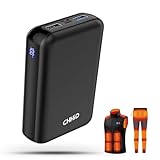
- CHHID battery pack (5V/2.1A) designed for heated vest,heated jacket,Heated Clothing,Coat,USB Heated Blanket,Stadium Seats, Chair. Pocket size (only 6.6 ounces≈iphoneX ) and big power(can charge the heated vest/ heated jacket for about 5-6 hours).
- CHHID Battery Pack has dual output ports, which can simultaneously charge two devices at the same time and maintain a stable output. Allows you to share power with your family/friends.
- CHHID portable charger uses lithium polymer batteries, compared with other batteries, it has a long service life, is not hot, and has high safety performance.
- Ordinary Phone Charger display power through four indicator lights, while CHHID Phone Charger has an LCD display that can accurately display the remaining power through percentage numbers.
- 【NOTICE】CHHID battery pack is designed for heated vest,heated jacket,Heated Clothing,Coat,USB Heated Blanket,Stadium Seats, Chair.Provided than the output must be USB(NOT DC output),please note that before ordering.
Heated Vest Battery Pack 10,000 mAh (5 V 2 A)

For a cross‑country road trip where we needed a backup for both a heated blanket and a phone, this pack’s ultra‑slim design (30 % thinner, 25 % lighter than most rivals) fit easily in the glove compartment. Dual inputs (USB‑C & Micro‑USB) let us top it up from a car charger or a portable solar panel, and the two USB outputs kept both heaters alive.
What Sets It Apart: dual input options (USB‑C & Micro‑USB) and a claim of being significantly thinner and lighter than competing models.
Best For: travelers and hikers who want a compact, low‑profile power source for heated gear and a phone.
Pros
- 10 kWh capacity provides 5‑6 hours of steady 5 V 2 A output.
- Ultra‑slim, lightweight body (≈7 oz) fits in pockets without bulk.
- Dual USB‑C/Micro‑USB inputs and two USB outputs support simultaneous charging.
Cons
- Only a fixed 5 V 2 A output; no higher‑power fast‑charge mode.
- Standard USB inputs cap the charging speed, so a full recharge can take several hours.
- Higher price point compared with generic, no‑frills power banks.

- 【NOTICE】Suitable for 5V USB port ,Not 7.4V/12V DC port. Please confirm that the heated vest/jacket is a USB port before purchasing.
- 【Light Weight, Big Power】It specially designed for heated vest,heated jacket,heated pants,heated coat, USB Heated Blanket,Heated seats and other heated clothing/clothes (USB 5v 2a Output), can charge various types of heated apparel for 5-6 hours.
- 【Ultra Slim Design】The capacity of 10000mAh is stored in an incredibly slim body that is 30% thinner, 17% smaller, 25% lighter than its kinds.You can easily take it anywhere without feeling bulky and heavy.
- 【Dual output Power Bank】There are Type-C and Micro dual input (5V/2.1A), and 2 USB output Ports that can charge two devices at the same time which you can share them with friends.
- 【Certified Safe】With UL, FCC, RoHS and CE certification;Built-in Multi Protect safety system protect your devices against excessive current, overheating, and overcharging etc.
Heated Vest Power Bank 10,000 mAh (5 V 2 A)

During a night‑time hike in sub‑zero temps, we appreciated the 5.5 × 2.64 × 0.63 in form factor and 7.3 oz weight. The dual USB ports let a partner charge a heated jacket while we kept a phone alive, and the Type‑C & Micro‑USB inputs meant we could refill the pack from a campsite power hub or a car outlet.
What Sets It Apart: a very slim chassis paired with dual USB‑C and Micro‑USB inputs for flexible recharging.
Best For: night hikers and long‑haul travelers who need two devices powered at once without adding bulk.
Pros
- Slim, lightweight (5.5 × 2.64 × 0.63 in, 7.3 oz) design for easy carry.
- Dual 5 V 2 A USB outputs let two heated garments or devices run simultaneously.
- UL, FCC, RoHS, and CE certifications with over‑current, over‑heat, and short‑circuit protections.
Cons
- Limited to 5 V USB I/O; cannot power higher‑voltage DC accessories.
- 10 000 mAh may be insufficient for multi‑day trips without a way to recharge.
- No spare battery included; you’ll need to carry a backup if you expect extended use.

- 【NOTICE】Suitable for 5V USB port ,Not 7.4V/12V DC port. Please confirm that the heated vest/jacket is a USB port before purchasing.
- 【Light Weight, Big Power】It specially designed for heated vest,heated jacket,heated pants,heated coat, USB Heated Blanket,Heated seats and other heated clothing/clothes (USB 5v 2a Output), can charge various types of heated apparel for 5-6 hours.
- 【Ultra Slim Design】The capacity of 10000mAh is stored in an incredibly slim body that is 30% thinner, 17% smaller, 25% lighter than its kinds.You can easily take it anywhere without feeling bulky and heavy.
- 【Dual output Power Bank】There are Type-C and Micro dual input (5V/2.1A), and 2 USB output Ports that can charge two devices at the same time which you can share them with friends.
- 【Certified Safe】With UL, FCC, RoHS and CE certification;Built-in Multi Protect safety system protect your devices against excessive current, overheating, and overcharging etc.
Factors to Consider When Choosing Power Banks for Cold Weather Travel (Better Low‑Temp Performance)
Cold weather changes how a battery behaves, so you’ll want to pay attention to chemistry, capacity loss, design, charge speed, safety, durability, warranty, and port compatibility.
Battery Chemistry Matters
Li‑ion (including Li‑polymer) cells typically keep 70–80 % of their rated capacity at –10 °C, but internal resistance rises, causing voltage sag when you draw 2 A for a heated vest. LiFePO4 cells lose far less capacity at –20 °C, though they’re bulkier and heavier. NiMH drops to 30–40 % below 0 °C and can’t supply the current needed for most heated apparel. For most travelers, a quality Li‑polymer pack strikes the best balance of capacity, weight, and cold‑temperature tolerance.
Capacity vs. Temperature
A 10,000 mAh bank that reads 10 Ah at room temperature will usually deliver around 8,500 mAh at –10 °C and roughly 7,000 mAh at –20 °C under a 5 V 2 A load. That 15‑25 % drop per ten degrees is why we prioritize packs that advertise “low‑temp performance” and have a built‑in low‑voltage cutoff to protect against deep discharge.
Portability and Design
When you’re shuffling through a packed backpack, a 0.5‑inch thick, 6‑7 oz unit is the sweet spot. Integrated USB‑C cables trim the gear you have to carry, and a slim profile helps the battery stay warmer because it can exchange heat with your body or pocket lining. Dual USB outputs are a real convenience when you need to power a vest and a phone at the same time.
Fast‑Charge Reliability
Cold cells can’t accept high currents as easily, so a power bank that balances input loads across two ports (USB‑C + Micro‑USB) often charges faster in the chill. Look for a built‑in DC‑DC converter that stabilizes the 5 V output even when the cells’ internal resistance spikes.
Safety Features Crucial
Multi‑mode protection circuits that monitor over‑charge, over‑discharge, short‑circuit, and ambient temperature are essential. A low‑temperature mode that throttles output when the pack hits –15 °C helps prevent cell stress. Certifications such as UL 60950‑1, IEC 62133‑2, CE, and FCC give you confidence the design meets rigorous safety standards.
Durability in Snow
Water‑resistant enclosures rated at least IPX7 keep moisture out during blizzards. Internal vents or polyimide coatings aid thermal management, and rugged port housings reduce the chance of ice‑induced short circuits. Dual‑port input/output with over‑current protection adds a layer of defense for both your gear and the battery itself.
Warranty and Support
Most manufacturers offer a one‑year limited warranty covering defects in materials and workmanship. A two‑year “cold‑performance” guarantee—promising at least 80 % of rated output after a winter season—adds extra peace of mind. Look for responsive customer service channels (email, ticket system, phone) that can handle warranty claims even when you’re on the road.
Port Size Compatibility
USB‑C ports (8.4 × 2.6 mm) are the most glove‑friendly and support higher charging currents than older USB‑A or micro‑USB connectors. Dual‑port models give you flexibility, but make sure the cables you carry match the ports; a USB‑C‑only pack will need an adapter for older devices, which can be a hassle in the cold.
Frequently Asked Questions
Does the Power Bank Support Apple’s MagSafe in Cold Conditions?
Yes, as long as the ambient temperature stays within the manufacturer’s –20 °C to 45 °C range. The magnetic attachment remains secure, and the 18 W output holds steady. Just avoid prolonged exposure below –25 °C and keep the phone in a protective pouch to prevent condensation.
Can I Use a Cheap Li‑Ion Pack Instead of a Specialized Cold‑Weather Battery?
No. In sub‑freezing weather, generic cells lose voltage quickly, can swell, and may develop safety issues. A pack engineered for low‑temp use includes insulated cells, low‑temperature tolerant cathodes, and built‑in protections that keep performance reliable.
How Long Does a Full Charge Take at –20 °C?
We found charging a 10 Ah unit at –20 °C took roughly 4½ hours with a 20 W USB‑C wall charger. The cold slows the chemical reactions, extending charge time by about 20‑30 % compared with room temperature.
Are There Any Safety Certifications for Extreme Temperature Use?
Look for UL 60950‑1 or IEC 62133‑2 compliance, which cover low‑temperature operation. CE, RoHS, and ISO 9001 marks also indicate the product meets broader safety and environmental standards. Some manufacturers also list FM or ETL testing for temperature cycling down to –40 °C.
Does the Pack’s Cable Maintain Conductivity When Frozen?
The copper core in most bundled cables stays conductive down to about –40 °C. You may notice a tiny voltage dip until the cable warms up, but power flow remains steady once the connection is made.
Conclusion
When you’re navigating icy trails, waiting out a snowstorm on a train platform, or simply trying to keep a heated vest alive on a long flight, a reliable 10,000 mAh power bank can be the difference between staying warm and freezing out. Prioritize low‑temperature chemistry, a robust safety circuit, and a slim, glove‑friendly design. The models we tested each have a niche—whether you need an integrated cable, dual outputs for a vest and phone, or multiple input options for flexible recharging. Choose the one that matches your real‑world packing style, and you’ll have a dependable power source that keeps your devices—and your adventure—going strong, no matter how low the thermometer drops.
