
Best USB Hubs for Connecting Multiple Devices

Introducing Maria, our meticulous planner and talented visual storyteller. She has a knack for discovering those hidden gems, chic boutique spots, and charming little cafes that add a touch of elegance to every journey. With her keen eye for photography and her passion for travel, Maria will transport you to the most enchanting corners of the world, inspiring you to explore new places, one picture-perfect destination at a time.
Look for a mix of 4‑port travel hubs and switches for power users. For travel, try the UGREEN 4‑Port Ultra‑Slim, Acer 4‑Port with a 2‑ft cable, or Anker 4‑Port; they’re plug‑and‑play and reach USB 3.0 speeds up to 5 Gbps. For setups, consider the ONFINIO 7‑Port with individual switches or the Sabrent 4‑Port with per‑port LEDs. If you need serious charging, the 200W GaN III 8‑Port hub handles eight devices at once. More options await.
Key Takeaways
- For expanding many peripherals, a 7-port hub with individual on/off switches provides per-port control and space for keyboards, drives, and more.
- For portable setups, choose a compact travel hub like a 4-port USB-C/USB-A 3.0 model.
- If you need real power, the 200W GaN III 8-Port USB-C charger hub can run eight devices at once.
- For fast, driver-free expansion on desktops and laptops, use standard USB 3.0 hubs offering up to 5Gbps and multiple ports.
- Ultra-slim hubs are ideal for laptops or consoles, delivering plug-and-play expansion in a compact form factor.
Acer 4-Port USB 3.0 Hub with 2ft Cable

Best for on‑the‑go users who need four high‑speed USB 3.0 ports from a slim, driver‑free hub. You get four USB 3.0 ports at up to 5Gbps, wrapped in a 2ft cable, model ACER-UH501 in black. It weighs 1.6 oz and measures 4.13 x 1.18 x 0.35 in, with a durable housing and enhanced heat dissipation. Plug‑and‑play keeps you moving without drivers. The LED indicates status while all four ports can run simultaneously. Note: HDDs need the 5V USB-C power port for stable data; the USB-C input can’t transfer data or charge. You can use it with laptops, desktops, rigs.
Best For: On-the-go users who need four high-speed USB 3.0 ports from a slim, driver-free hub.
Pros:
- Four USB 3.0 ports with up to 5Gbps data transfer in a single, plug-and-play hub
- Slim, portable, lightweight design with a 2ft cable and durable housing
- LED status indicator and support for all four ports operating simultaneously
Cons:
- USB-C input is power-only; it cannot transfer data or charge devices
- HDDs require the 5V USB-C power port for stable data; without it, data stability may suffer
- Real-world speeds may vary due to host bandwidth and four-port sharing

- 【4 Ports USB 3.0 Hub】Acer USB Hub extends your device with 4 additional USB 3.0 ports, ideal for connecting USB peripherals such as flash drive, mouse, keyboard, printer
- 【5Gbps Data Transfer】The USB splitter is designed with 4 USB 3.0 data ports, you can transfer movies, photos, and files in seconds at speed up to 5Gbps. When connecting hard drives to transfer files, you need to power the hub through the 5V USB C port to ensure stable and fast data transmission
- 【Excellent Technical Design】Build-in advanced GL3510 chip with good thermal design, keeping your devices and data safe. Plug and play, no driver needed, supporting 4 ports to work simultaneously to improve your work efficiency
- 【Portable Design】Acer multiport USB adapter is slim and lightweight with a 2ft cable, making it easy to put into bag or briefcase with your laptop while traveling and business trips. LED light can clearly tell you whether it works or not
- 【Wide Compatibility】Crafted with a high-quality housing for enhanced durability and heat dissipation, this USB-A expansion is compatible with Acer, XPS, PS4, Xbox, Laptops, and works on macOS, Windows, ChromeOS, Linux
Anker 4-Port USB 3.0 Hub for Laptop

This 4-port USB 3.0 hub is ideal for laptop users who need to add multiple USB-A connections without adding bulk. You get four ports from USB-A input, with USB 3.0 up to 5Gbps for HD movie transfers.
Charging isn’t supported, so you stay in control. It weighs 1.76 ounces and measures 27.68 x 1.18 x 0.39 inches, keeping your setup tidy. AK-A7516012 includes a 2ft USB-A cable, the slim data hub, a welcome guide, and an 18-month warranty with support. Trusted by 80 million+ users and sits at #2 in USB Hubs with a 4.7/5 rating from 135,885 reviews.
Best For: Laptop users who need extra USB-A ports without bulk, want USB 3.0 speeds up to 5Gbps, and don’t require power charging.
Pros:
- Expands a single USB-A port into four USB 3.0 ports with speeds up to 5Gbps.
- Ultra-portable and slim: weighs 1.76 oz and compact 27.68 x 1.18 x 0.39 inches.
- Includes a 2ft USB-A cable and comes with an 18-month warranty and reliable support.
Cons:
- Not designed to charge devices; power comes from the host.
- Short 2ft cable may limit placement in larger setups.
- Bandwidth is shared across four ports, which can affect performance with multiple high-speed devices.
](https://m.media-amazon.com/images/I/31EVVjapPYL._SL160_.jpg "Best USB Hubs for Connecting Multiple Devices 5")
- The Anker Advantage: Join the 80 million+ powered by our leading technology.
- SuperSpeed Data: Sync data at blazing speeds up to 5Gbps—fast enough to transfer an HD movie in seconds.
- Big Expansion: Transform one of your computer's USB ports into four. (This hub is not designed to charge devices.)
- Extra Tough: Precision-designed for heat resistance and incredible durability.
- What You Get: Anker Ultra Slim 4-Port USB 3.0 Data Hub, welcome guide, our worry-free 18-month warranty and friendly customer service.
ONFINIO 7-Port USB 3.0 Hub with Switches

Anyone juggling multiple peripherals will appreciate the ONFINIO 7-Port USB 3.0 Hub with Switches, which gives you independent on/off switches on every port for precise control and easy energy management. With seven USB 3.0 ports and independent on/off switches, you control power to every device without unplugging. The compact, portable hub stays out of the way while you’re expanding your setup.
You get speeds up to 5Gbps, and USB 2.0/1.0 compatibility. 3.2 ft cable keeps it reachable; each port has indicator lights visible. Plug-and-play, hot-swapping supported; external power helps devices. OS compatibility spans Windows, Mac, Linux, and Chrome OS.
Best For: Users who need independent on/off control for multiple USB peripherals in a compact 7-port hub with energy management.
Pros:
- Independent on/off switches for every port enable precise power control and easy energy management.
- Seven USB 3.0 ports with up to 5Gbps speeds, plus plug-and-play and hot-swapping.
- Backward compatible with USB 2.0/1.0 and supports external power for power-hungry devices.
Cons:
- External power supply is recommended for high-power devices; without it, some devices may not function reliably.
- No USB-C port; uses USB-A 3.0, which may limit compatibility with newer devices.
- Seven switches and LEDs can add bulk and may wear with frequent use.

- [7-Port USB 3.0 Hub] ONFINIO USB hub turns one USB port into Seven, support for USB Flash drive, Mouse, Keyboard, Printer, or any other USB Peripherals. And it's backward compatible with your older USB 2.0 / 1.0 devices.
- [5Gbps Data Transfer Speed] This USB hub splitter 3.0 syncs data at blazing speeds up to 5Gbps, which is more than 10 times faster than USB 2.0, fast enough to transfer an HD movie in seconds.
- [Easy to Use] This USB port hub has a built-in high-performance chip to keep your devices and data safe, and supports hot swapping. No need for installation of any software, drivers, plug and play. Please offer extra power supply when the power-hungry devices are connected.
- [Compact & Portable] The USB extension cable multiple port has been intelligently designed to be as slim and light as possible, ideal for your working and traveling with ultrabook. Exquisite gift box packaging, easy to store and use.
- [Wide Compatibility] ONFINIO usb hub for laptop is compatible with Windows 10/8/8.1/7 / Vista / XP and Mac OS X, Linux, and Chrome OS. USB expander applies to various devices: laptop, pc , XBOX, PS4, flash drive, printer, mouse, card reader, HDD, keyboard, camera, console, USB fan.
UGREEN USB 3.0 Hub 4-Port Ultra-Slim

If you need to add four USB-A ports to a laptop or console on the go, the UGREEN USB 3.0 Hub 4-Port Ultra-Slim is a compact, plug‑and‑play solution. Ultra-slim at 0.4 in thick and weighing 33 g, it comes in black as model 25851 and works with laptops, desktop PCs, Xbox Series, PS5, and other devices.
With USB 3.0, you reach up to 5 Gbps and a 10 GB transfer in 16.4 seconds. It expands USB-A port to four, plug‑and‑play with no drivers, and works with Windows, macOS, Linux, and Chrome OS. Use it for mice, keyboards, and drives.
Best For: Travelers and gamers who need extra USB-A ports on laptops or consoles while on the go.
Pros:
- Ultra-slim and lightweight design (0.4 in thick, 33 g) for easy portability.
- USB 3.0 speeds up to 5 Gbps, with a 10 GB transfer in about 16.4 seconds.
- Plug-and-play with no drivers and expands to four USB-A ports from a single USB-A host port.
Cons:
- Only USB-A ports; no USB-C or dedicated charging port.
- Bandwidth is shared across all four ports, so performance can vary when multiple devices are connected.
- Real-world speeds can vary and depend on the host USB port and connected devices.

- 4 USB Ports Expansion: This USB Hub turns 1 USB A port into 4 USB A ports with your devices for mouses, keyboards, U disks, flash drives, and more USB Peripherals. Greatly improve your work efficiency
- Transfer Files in Seconds: The USB 3.0 Hub supports a max file transfer speed of 5Gbps. That's fast enough to transfer a 10 GB file in just 16.4 seconds
- Plug and Play: No additional drivers or software are required. The USB multiport adapter is plug-and-play for Windows, macOS, Linux, Chrome OS, and More
- Wide Compatibility: In addition to laptops and desktop computers, this USB 3.0 splitter also supports other devices with USB A such as Xbox Series, PS5, car systems, etc., which can meet the various needs of your daily life
- Compact Mini Size: This USB A hub is designed to be very compact and portable, which is only 0.4 inches thick and 33g heavy. It is very suitable for your travel and business trips

4-Port USB Hub USB-C and USB-A 3.0

A compact 4-port USB-C and USB-A 3.0 hub is ideal for travelers, students, or anyone who needs fast, simultaneous USB expansion from a single portable device. It lets you use two USB-C 3.0 ports and two USB-A 3.0 ports, four ports total, that all run at 5Gbps and deliver USB 3.0 bandwidth. USB-C ports boost compatibility; no USB-A-to-C adapter needed.
PD charging and display output aren’t supported. It’s ultra-slim, plug-and-play; no drivers. OS compatibility includes Windows, macOS, Linux, Chrome OS. Use it with laptop, PS4, drive, Xbox, printer, mouse, or keyboard. 4.1 x 1.14 x 0.35 inches; 1.41 ounces.
Best For: Travelers and students who need a compact, plug-and-play 4-port USB-C/USB-A 3.0 hub to expand laptop or console USB with fast 5Gbps bandwidth.
Pros:
- Ultra-slim, portable design ideal for travel and on-the-go use.
- Four ports (2 USB-C 3.0, 2 USB-A 3.0) with up to 5Gbps total bandwidth; no drivers required.
- Broad OS compatibility and plug-and-play with no driver installation.
Cons:
- No PD charging (power delivery) support; cannot charge devices through the hub.
- No display output or monitor support.
- Performance depends on the host USB port and may share bandwidth across all ports.

- 【4 Real USB 3.0】All 4 ports of this usb hub are USB3.0 and can be used simultaneously. 5Gbps transfer speed can meet most users' needs. Equivalent to 4 USB 3.0 cables, absolutely a great usb splitter for laptop.
- 【USB-A and USB-C】Considering that usb c port is more popular, this usb to usb c hub will be more practical, 2 USB C 3.0 ports for more device compatibility and no need for additional usb a to usb c adapterr. 【Please Note】PD charging and monitor is not supported.
- 【Portable Design】This mini usb adapter takes up almost no space, plug and play and no drivers required, there is no better computer accessories than this. Great portable keyboard and mouse hub.
- 【Great Compatibility】This 4 port usb a hub compatible with Windows 11, 10, 8.1, 8, 7 (32/64 bit), Mac OS 10.12 and above, Vista / XP and, Linux and Chrome OS. It's really a great usb extender for laptops.
Sabrent 4-Port USB 3.0 Hub with LEDs

For on-the-go users who want precise control over connected devices, the Sabrent 4-Port USB 3.0 Hub with LEDs is ideal: four USB 3.0 ports in a slim, portable shell, each with its own LED indicator and power switch. A 2 ft cable provides flexible placement, and the hub’s plug & play.
Performance reaches up to 5 Gbps on USB 3.0, compatible with USB 1.1, 2.0, and USB drives, PCs, Macs, Linux systems. Not charging, but individual port switches let you disconnect devices as needed; LEDs clearly show activity. Setup requires no drivers, and 2 ft cable offers flexible placement.
Best For: On-the-go users who need compact USB 3.0 expansion with per-port power switches and LEDs for precise device control.
Pros:
- Per-port power switches for easy disconnect and control
- Individual LED indicators and USB 3.0 speeds up to 5 Gbps
- Slim, portable design with a 2 ft cable and plug-and-play setup
Cons:
- Not a charging hub; cannot charge devices through the hub
- Only four ports, which may be limiting for many peripherals
- Placement may be limited by the fixed 2 ft cable length
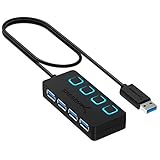
- EXPANDABILITY: Instantly add 4 USB 3.0 ports to any compatible device. The 2 ft cable allows for flexible setup and easy access to hard-to-reach ports.
- USER-FRIENDLY DESIGN: LED indicators show power status for each port. Individual on/off switches let you connect/disconnect devices effortlessly.
- HIGH-SPEED DATA TRANSFER: Supports speeds up to 5Gbps (USB 3.0), 480Mbps (USB 2.0), & 12Mbps (USB 1.1). Transfer large files in seconds.
- BROAD COMPATIBILITY: Works with USB 2.0 and USB 1.1 devices. Compatible with PC, MacBook, iMac, Mac mini, XPS, Flash Drives, and more.
- EASY INSTALLATION: No driver needed; Plug & Play and Hot Swappable. Note: Not for charging.
200W GaN III 8-Port USB-C Charger Hub

Power users who need eight devices charging simultaneously without slowing any port you’ll appreciate this GaN III 8-Port USB-C Charger Hub, delivering full-speed performance on every connection. Independent ports deliver eight outputs: 4 USB-C, 4 USB-A, so you can charge eight devices simultaneously with no power sharing, preserving full-speed per port. Your desk stays organized, reducing the need for extra accessories. GaN III tech powers the hub with a chipset and built-in multi-protection, boosting energy efficiency, improving heat dissipation, and keeping your unit small and radiation resistant.
65W and 30W ports power; MacBook Pro 55% in 30 minutes today.
Best For: Power users who need eight devices charging simultaneously with independent, full-speed ports and a compact GaN III hub for desks, home offices, or travel.
Pros:
- Independent eight ports with no power sharing deliver full-speed per port, allowing eight devices to charge simultaneously.
- GaN III technology with multi-protection delivers higher efficiency, better heat dissipation, and a smaller, safer, radiation-resistant design.
- 65W and 30W USB-C PD ports enable fast charging for laptops and devices, with broad compatibility across MacBook Pro/Air, Dell XPS, iPhone, Samsung Galaxy, iPad, Steam Deck, and more.
Cons:
- Only two USB-C PD ports (one 65W and one 30W) may limit fast charging for multiple high-power devices at once.
- If all eight ports draw near their max, the total 200W budget could reduce per-port speeds in real-world high-load scenarios.
- Desk setup can become cluttered due to eight ports and the hub’s cabling; may require mindful cable management.

- 【4 USB-C & 4 USB-A Ports Independently Charging 8 Devices at Once】We USB C Charger Block Unlike most chargers with false advertising and outputs that slow down when multiple ports are used, We USB C charging stations feature 8 independent output ports, ensuring all devices can charge simultaneously at full speed without power sharing and disconnection. this 8-in-1 charging station will reduce your accessories burden and help you create an organized and clean desktop.
- 【Latest GAN III Chip Technology Charger Station】The USB C charger adapted GaN III generation chip technology, built-in multi-protection system and premium microchips. With higher energy efficiency, higher resistance to radiation and upgraded heat dissipation, Gallium Nitride (GaN) makes our chargers smaller and safer without sacrificing a drop of power
- 【Upgraded 65W boost Macbook Pro up to 55% in 30 Mins】With the inspiring 65W and 30W outputs, GKUTW's USB-C charger block can super-fast charge 1 laptop, 2 phones/tablets and 5 others at once,from large to small, the usb-c power adapter compatible with 1000+ devices include MacBook Pro/Air, Microsoft Surface, Dell XPS, Samsung Galaxy, iPad Pro, Steam Deck, iPhone, Google Pixel, covering a whole family needs and save money&space.
- 【Universal Compatibility smartphones / tablets ect】USB-C port and USB-A port charger block for iPhone 15/14/13/12/11/X/Pro Max /Mini Plus/ XS Max/ XS/ X/ XR/ 8 Plus/ 8, iPad Pro Air Mini, AirPods Pro, Samsung Galaxy S23/S23+/S23 Ultra/ S22/ S22+/ S22 Ultra/ S21/S21+/S21 Ultra/ S21+ 5G, S20/ S20 Ultra/ S20+/ S20 FE, Note 10/ Note 10 5G, Note 20/ 20 Ultra 5G/ S10 5G, Galaxy Z Fold 3 5g, A90 5G, A80, A70, Book S, Tab S7/S7+/S8/S8+/S8 Ultra, and switch, speaker, lamp, etc.
- 【Portable USB C Charging Station Compact and Portable】Multiport USB C Charger Station perfectly charges multiple devices for home, office and travel. Small size saves you 50% space and fits easily into pockets, handbags, travel cases. The 5ft/1.5m power cord for this multiple fast charger station can be extended to the desktop, bedside, counter, nightstand, service desk, etc.
Upoy 5-Port 40W USB Charging Station

This compact desktop charging hub is ideal for home offices or boats where you need to power multiple devices without clutter. The Upoy 5-Port 40W station features a sailboat-inspired, compact shell built with a hot runner process and 1382°F anti-combustion protection, delivering heat dissipation and space-saving design.
Power and ports: 40W total, six devices for you. A port to 2.4A; Type-C 3A. IC and Smart Flow tailor current per device, with protections for over voltage, over current, over temperature, over charge, short circuit, and disconnect. Dimensions are 3.11 by 1.77 by 4.4 inches, it’s 7.5 ounces; iPhone, iPad, tablets.
Best For: Compact, space-saving charging hub ideal for home offices or boats that need to power multiple devices without clutter.
Pros:
- Space-saving, sailboat-inspired design with heat dissipation and 1382°F anti-combustion protection for safe desk or boat use.
- Smart IC/Smart Flow optimizes current per device, with per-port up to 2.4A (and Type-C 3A) to charge a variety of devices safely.
- 40W total output supports multiple devices simultaneously (up to six), with broad compatibility for iPhone, iPad, tablets, and smartphones.
Cons:
- 40W total may limit charging speed when several high-demand devices are connected.
- Per-port current limits (2.4A standard, 3A on Type-C) may not meet the fastest charging needs of some devices.
- Some spec details appear inconsistent (5-Port design vs. claims of six devices), which could cause confusion about actual port count and throughput.
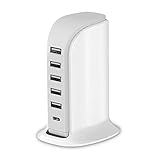
- Desktop Charging Hub sailing boat design: Hot runner process shell, 1382℉ anti-combustion, compact Sailboat shape for extreme heat dissipation and space-saving.
- USB Plug Adapter 30-Watt: 40W total power output for Android and IOS, get rid of various charger.
- 6 in 1 USB Charger Block: Support 6 devices simultaneously, quick charger up to 2.4A for single USB port.
- Charging Station with Smart IC: Smart Flow technology offers suitable current for every single device plugged.
- Charging Tower with 6 protections: 24h Over voltage protection, over current protection, over temperature protection, over charge protection, short circuit protection, disconnect protection.
PANPEO 7-Port USB 3.0 Hub with LED

Ideal for students and remote workers who need to expand a laptop’s USB, the PANPEO 7-Port USB 3.0 Hub with LED adds seven fast ports and per-port LED indicators. With a 3ft built-in cable, it’s plug‑and‑play, lightweight, and travel‑ready for home, office, or school. It transfers data up to 5 Gbps, is backward compatible with USB 2.0/1.0, and does not support charging, so you power peripherals from your device. Use it with laptops, PCs, Surface Pros, PS4/5, flash drives, keyboards, mice, HDDs, and printers. LEDs are independently controllable to show activity per port. Compact enough for desks and bags.
Best For: Students and remote workers who need to expand a laptop’s USB ports for added versatility and per-port activity indicators.
Pros:
- Seven USB 3.0 ports with up to 5 Gbps total throughput and independent per-port LEDs.
- Plug-and-play, lightweight design with a built-in 3-foot cable, ideal for travel and on-the-go setups.
- Backward compatible with USB 2.0/1.0 and does not require external power for typical peripherals.
Cons:
- Does not support charging; relies on the host device to power connected peripherals.
- May not provide enough power for high-power devices like certain external HDDs or printers without a powered hub.
- Built-in 3-foot cable may be too short for some desktop or hard-to-reach setups.

- 【Multiple USB Port】 Turn one USB port into seven, including support for USB Flash drive, Mouse, Keyboard, Printer or any other USB Peripherals. And it's backward compatible with your older USB 2.0 / 1.0 devices.
- 【Usb hub Long cable】: as long as 3ft length build in import cable, enhanced connectivity to hub body, dispel your concerns for too short to connect to your pc/tablet.
- 【Compact & Portable】It's very easy to use, just plug and play. Light weight make it easy to carry and suitable for your travel, office, home and school.
- 【5Gbps Data Transfer Speed】:This USB hub 3.0 syncs data at blazing speeds up to 5Gbps, which is more than 10 times faster than USB 2.0, fast enough to transfer an HD movie in seconds. NOTE: This USB Hub doesn’t support charging.
- 【Wide Appliaction】Multi usb port applies to various devices: laptop, pc, flash drive, keyboard, mouse, HDD, XBOX, PS4, cellphone OTG adapter, printer, camera, USB fan and USB cables.
VIENON 4-Port USB 3.0 Hub Rotatable PD-in

For Mac laptops and in-car setups that need extra USB ports, the VIENON 4-Port USB 3.0 Hub Rotatable PD-in offers a rotatable 90°/180° body with a USB-C PD-in power input. Four ports give you one USB 3.0, two USB 2.0, and a USB-C female port. You get USB 3.0 up to 5 Gbps, while USB 2.0 runs at 480 Mbps for Mac mini. It’s plug-and-play, you won’t need drivers, and it works with Windows, macOS, and Linux; you won’t charge devices. You can use Mac Pro, iMac, MacBook Air, MacBook Pro; it suits Tesla Model Y and Model 3.
Best For: MacBook users and in-car setups that need extra USB ports, with a rotatable hub and USB-C PD-in power input.
Pros:
- Rotatable design for flexible placement in desks or cars.
- USB-C PD-in powers the hub without requiring a separate charger.
- Plug-and-play with driver-free operation on Windows, macOS, and Linux.
Cons:
- No charging output to connected devices; power input only.
- Only one USB 3.0 port; the other ports are USB 2.0, which can bottleneck faster peripherals.
- Not suitable for audio/video transfer or sound devices.
![VIENON 4-Port USB 3.0 Hub [90°/180° Degree Rotatable], USB Splitter with PD-in 5W USB C Port, USB Extender for Laptop, Car, iMac, MacBook Air, MacBook Pro, and More](https://m.media-amazon.com/images/I/31KyAOXX0TL._SL160_.jpg "Best USB Hubs for Connecting Multiple Devices 22")
- 【USB Port Expander】:This 4-Port USB hub can easily expand one of your computer’s USB ports into 3 USB port and 1 Type C port. Support 4 ports to work at the same time, without any pressure, and keep the temperature in the middle range. Plug and play, no need driver, easy to use.
- 【USB C Power & Data Port】: The USB C female port supports 5V Power supply for the hub, as well as the data transfer, which allowing you to connect to Type C phones, mobile hard drives, and other devices for data transfer has solved the problem of your laptop and computer lacking USB C interfaces. (Note: this usb c port only support power input for the hub, not support power output for charging).
- 【Wide Application】: Ideal for Mac Pro, iMac, MacBook Air, MacBook Pro, MacBook, and Mac mini. And this is also very suitable for use in the car. It extends the USB interface in the car, compatible with esla Model Y 2021-2024 and Model 3 2021-2023 and other Car. (Note: not support audio & video transfer, not compatible with any sound devices)
- 【SuperSpeed Transmission】:With 1 x USB 3.0 port and 2 x USB 2.0 ports. The USB 3.0 interface has a data transfer speed of up to 5Gbps, and can download a high-definition movie in just a few seconds. It is very suitable for inserting USB drives, mobile hard drives, cameras, and other devices for fast data transfer. Two USB 2.0 interfaces with a speed of 480Mbps, suitable for inserting USB peripheral devices such as mice, keyboards, printers, etc.
- 【Plug & Play】: Support hot-swappable on Windows 7/ Vista/ XP/ 2000/ ME/ 98/ 8/ 10; Mac OS 8.6-9.2/ OSX-10.6, and Linux.
BERLAT Aluminum USB-C 7-in-1 Hub with USB 3.0/2.0

If you need a compact, all-in-one USB-C hub to power multiple devices from a single laptop, the BERLAT 7-in-1 delivers fast data and broad compatibility in a slim aluminum chassis. It gives you 1 USB 3.0 port, 4 USB 2.0 ports, USB-C 2.0 ports, with 5 Gbps on USB 3.0. Use it to move videos, music, photos, and files, with broad OS support from MacBook Pro/Air to Windows, Android, Chrome OS, and Linux everywhere today. You’ll notice its aluminum body, measuring 4 by 1 by 0.5 inches, weighing 1.41 ounces, and matching with laptops, PC towers, Xbox, and PS4.
Best For: Travelers and professionals who need a compact, all-in-one USB-C hub to expand a laptop’s connectivity and transfer media quickly.
Pros:
- Ultra-compact aluminum body that’s portable
- 7-in-1 setup with 1× USB 3.0, 4× USB 2.0, and 2× USB-C 2.0 for broad device support
- High-speed data transfer on USB 3.0 up to 5 Gbps and broad OS compatibility
Cons:
- Only one USB 3.0 port; the rest are USB 2.0 or USB-C 2.0, limiting high-speed transfers
- USB 2.0 performance for most devices may bottleneck large file transfers
- No built-in video outputs (HDMI/DisplayPort) or Ethernet, so it isn’t a full docking station

- 【7 in 1 Multi-functional Hub】 USB C hub with 1 x USB 3.0 port and 4 x USB 2.0 ports, 2 x USB C 2.0 port . USB 3.0, 5Gb/s transfer speed , USB 2.0: 480bps transfer speed, quickly transfer and download videos, music, photos and other files.
- 【Wide Compatibility】 This USB C hub Compatible with USB-C compatible with MacBook Pro/MacBook Retain/MacBook Air or devices with a Type C port,Windows 10, MacOS X, Android, Chrome OS Google (Up), Linux with the latest updates day.
- 【High-Speed Data Transfer】The usb c hub and usb hub equipped with USB Hub 3.0 port, this extra ports for laptop hub enables fast data transfer speeds of up to 5Gbps, allowing you to transfer large files, photos, and videos in seconds. Enjoy a seamless and efficient workflow with this powerful expansion dock.
- 【Wide Appliaction】BERLAT 7-port USB Extender applies to various devices: laptop, pc tower, XBOX, PS4, flash drive, keyboard, mouse, card reader, HDD, cellphone OTG adapter, printer, camera, USB fan or any other USB Peripherals.
- 【 Sleek and Portable Design】Featuring a compact and lightweight design, this USB Type-C expansion dock hub is perfect for on-the-go use. Its durable aluminum alloy casing ensures long-lasting performance, making it an essential accessory for your devices.
VIENON Aluminum USB-C Hub 7-in-1 with USB 3.0

This 7-in-1 USB-C hub is a smart choice for USB-C laptops that need fast data transfers and multiple peripheral options in one compact package. You get a mix of ports: 1 USB 3.0, 4 USB 2.0, and 2 USB-C 2.0, plus dual plug compatibility for MacBook Pro, MacBook Air, iMac, PS4 Pro, Surface Pro, PC, and other laptops. It supports simultaneous connections, with USB 3.0 data speeds up to 5 Gbps and USB 2.0 up to 480 Mbps, so transfers stay smooth while you’re multitasking.
Aluminum shell delivers durability and fast heat dissipation; cables stay flexible and reliable overall.
Best For: USB-C laptop users who want a compact, durable 7-in-1 hub to expand peripherals with fast USB 3.0 transfers and broad compatibility.
Pros:
- USB 3.0 port delivers data speeds up to 5 Gbps for fast transfers while multitasking.
- Broad compatibility across Mac, Windows, Android, and other systems with dual plug support for multiple devices.
- Durable aluminum alloy shell with good heat dissipation and flexible, reliable cables.
Cons:
- Most ports are USB 2.0, with only one USB 3.0 port, which limits high-speed performance for some peripherals.
- No HDMI/video output or built-in card reader; limited to USB peripherals only.
- USB-C 2.0 ports are slower than newer USB-C standards, reducing potential performance on some devices.
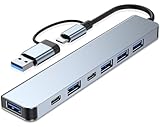
- 【Dual Plug USB C & USB Hub】: The combination of USB-A and USB-C is designed to allow one device to compatible with variety apple macbook pro, mac air, imac, ps4 pro, surface pro, computer, laptops and other devices simultaneously . This USB 3.0 hub USB C hub save users time and equipment costs
- 【7 in 1 Multi-functional USB Extender】: VIENON USB C docking station with 1 x USB 3.0 port and 4 x USB 2.0 ports, 2 x USB C 2.0 port . USB 3.0, 5Gb/s transfer speed , USB 2.0: 480bps transfer speed, quickly transfer and download videos, music, photos and other files.
- 【Wide Compatibility】: This USB splitter Compatible with USB-C compatible with MacBook Pro/MacBook Retain/MacBook Air or devices with a Type C port,Windows 10, MacOS X, Android, Chrome OS Google (Up), Linux with the latest updates day.
- 【Wide Appliaction】:VIENON 7-port USB Extender usb c adapter applies to various devices: laptop, pc tower, XBOX, PS4, flash drive, keyboard, mouse, card reader, HDD, cellphone OTG adapter, printer, camera, USB fan or any other USB Peripherals.
- 【Good Quality】: This usb hub usb c docking station comes with Aluminum alloy shell, beautiful, durable, and fast heat dissipation. The cables are flexible and sturdy, provide adequate protection and last longer. Ensure a stable connection between the external device and the computer.
USB-A$USB-C HUB, 7Ports Hub (USB-C)

Ideal for expanding a USB-C or Thunderbolt laptop’s peripherals with seven ports—three USB-C and four USB 3.0—via a plug-and-play, data-only hub that doesn’t support Power Delivery. With three USB-C and four USB 3.0 ports, it’s a plug-and-play solution offering up to 5 Gbps and compatibility with USB-C, Thunderbolt 3, and Thunderbolt 4. No drivers required; supports Windows, macOS, Linux, iPadOS, ChromeOS. It’s data-only, so the USB-C port won’t charge laptops. A 3.2-foot cable keeps your setup tidy, while the slim 4.1 x 0.67 x 1.3-inch, 0.15 lb body stays unobtrusive. OTG lets you connect peripherals directly to USB-C devices.
Best For: Users who need a compact, data-only USB-C/Thunderbolt hub to expand peripherals on USB-C or Thunderbolt laptops without charging capability.
Pros:
- Plug-and-play with no driver installation required on Windows, macOS, Linux, iPadOS, and ChromeOS.
- Seven-port versatility: three USB-C and four USB 3.0 ports for broad peripheral expansion.
- Compact, lightweight design with a 3.2 ft cable for tidy desk setups.
Cons:
- No Power Delivery passthrough; cannot charge laptops or power connected devices.
- Data-only hub; no monitor support or video output.
- OTG support may vary by device; not all USB-C devices will enable OTG functionality.

- 【Hybrid 2-in-1】USB C HUB . Has both USB-A and USB-C connectors, with 3.2 ft cable .7 Ports USB 3.0 HUB, with 3*USB C Ports and 4*USB 3.0 Ports★NOTE: The HUB does not aceept USB C Power Adapters for Power Delivery pass through to laptop★
- 【Ultra Compatibility&Plug and Play】Ultra Compatibility: Compatible with USB C ,Thunderbolt3 ,Thunderbolt 4 . Driver setup Plug and Play .Compatible with Windows,Mac OS,Linux, iPad OS ,Chrome OS.(Data Transfer only,Not Support Power and Monitor)
- 【Products Size】 4.1*0.67*1.3 inches, and 3.2 ft cable. weight 0.15 lb
- 【5G Hign speed】5Gbps High Speed: Transfer HD movies or large files in just seconds with super fast data transfers of speed up to 5Gbps, 10X faster than USB 2.0 (480 Mbps). Onten USB C hub, with built-in OTG function chip, easily connects with (wireless/wired) mouse, keyboard, USB drive, and other USB devices to your USB-C phone or tablet.
- 【Note】Note: The USB C Power port is only for a stable data transfer connection and can't charge laptops.
WIRWTRU 7-Port USB 3.0 Hub with On/Off Switches

For anyone who needs reliable, plug‑and‑play USB expansion with precise device control, the WIRWTRU 7-Port USB 3.0 Hub shines thanks to its individual port switches. You get seven USB 3.0 ports at up to 5 Gbps, backward compatible with USB 2.0/1.0, and compatibility across PC, Mac, desktop, PS5, and Xbox. Charging isn’t supported. Each port has its own on/off switch with blue LEDs showing active status. Its compact, slim design fits ultrabooks. Includes USB extension cable; slim, light. Dimensions are 7.76 x 3.54 x 1.26 inches; weighs 5.3 ounces. Gift box packaging keeps it safe, easy to store too.
Best For: Professionals and students who need a compact, plug‑and‑play 7‑port USB 3.0 hub with per‑port on/off switches for precise device control and ultrabook portability.
Pros:
- Seven USB 3.0 ports with data transfer up to 5 Gbps.
- Individual on/off switches per port with blue LED indicators for easy status visibility.
- Compact, slim design with included USB extension cable, ideal for ultrabooks.
Cons:
- Charging not supported; cannot charge devices through the hub.
- Bus-powered with no external power adapter, which may limit power to high-draw peripherals.
- Lacks USB-C/Power Delivery; uses USB 3.0 only and may not be ideal for newer devices.

- [USB PORT HUB EXPANDER] 7 port usb hub which makes it very easy to connect Multi USB devices to your PC, laptop simultaneously, such as keyboard, mouse, card reader, mobile HDD, webcam etc 𝙉𝙊𝙏𝙀:𝘾𝙝𝙖𝙧𝙜𝙞𝙣𝙜 𝙉𝙤𝙩 𝙎𝙪𝙥𝙥𝙤𝙧𝙩𝙚𝙙
- [5GBPS DATA TRANSFER SPEED] The USB 3.0 Hub extension provides up to 5 Gbps data transfer speed, which is more than 10 times faster than USB 2.0, and it is backwards compatible with USB 2.0/1.0
- [INDIVIDUAL ON/OFF SWITCHES] WIRWTRU USB hub has built-in on and off switches with led indicators for each port, being able to turn on or off the separate USB port without unplugging the equipment, blue LED lights let you know the working status easily.
- [WIDE COMPATIBILITY] USB Hub is compatible with the most operating systems: Windows XP/Vista/7/8/10/11; MacOS-8/9/X, UNIX, Linux and offers fast PLUG-AND-PLAY installation.
- [COMPACT & PORTABLE] The USB extension cable multiple port has been intelligently designed to be as slim and light as possible, ideal for your working and traveling with ultrabook. Exquisite gift box packaging, easy to store and use.
ANYPLUS USB 3.0 4-Port Hub, Portable

Perfect for travelers and laptop users, this compact ANYPLUS USB 3.0 4-Port Hub lets you expand a single port into four with plug‑and‑play ease and no driver required. It’s a 4-port USB 3.0 hub for data transfer and peripheral connections, not charging, with a 900mA max output.
USB 3.0 delivers up to 5Gbps, backward-compatible with USB 2.0 (480Mbps) and USB 1.1 (12Mbps). It supports Windows, macOS, Linux, Chrome OS, drives, printers, keyboards, mice, cards, and HDDs. Dimensions: 1.42 x 0.43 x 3.66 inches, 1.59 ounces. HDDs needing over 900mA require power. ASIN B0BWH9DZRV; Rank #11 in USB Hubs today.
Best For: Travelers and laptop users who need to expand a single USB port into four for data transfer and peripheral connections (not for charging).
Pros:
- Expands a single USB port into four for multiple peripherals.
- USB 3.0 speeds up to 5Gbps and is backward-compatible with USB 2.0/1.1.
- Plug-and-play with no driver required; compact, travel-friendly design.
Cons:
- Not suitable for charging; power is limited to 900mA.
- HDDs drawing more than 900mA require an external power adapter.
- Performance may vary with host USB port power and when multiple devices are connected.

- 【Multi Usb Port】This USB hub can easily expand one USB port of the computer to four ports, support four ports to work at the same time, without any pressure, and keep the temperature in the middle range. Plug and play, no driver required, easy to use
- Note: This hub is not suitable for charging devices as its maximum output current is only 900mA, resulting in very slow charging speeds. Therefore, it is recommended to use it solely for data transfer and peripheral connections to ensure optimal performance.
- 【Wide Compatibility&Appliaction】This usb hub for laptop is compatible with Windows 10/8/8.1/7 / Vista / XP and Mac OS X, Linux, and Chrome OS. 4-port USB expander applies to various devices: laptop, pc tower, XBOX, PS4, flash drive, printer, mouse, card reader, HDD, cellphone OTG adapter, keyboard, camera, console, USB fan and USB cables
- 【High-Speed Data Hub】Supports Transfer Speeds up to 5Gbps (USB 3.0), 480Mbps (USB 2.0), and 12Mbps (USB 1.1). Note: This hub support output max current up to 900mA.So some HDDs that need a current of more than 900mA need an external power adapter
- 【Hassle-free Service】ANYPLUS Our Team Has Professional Technical Team And Great Customer Service.24-Hour Online Customer Service. If there is any problem with the product, Please Feel Free To Contact Us And We Will Do Our Best To Solve Your Problem
Factors to Consider When Choosing USB Hubs for Multiple Devices
To pick the right USB hub, you first assess how many ports you need, since port count sets your expandability. Then you check power delivery limits, data speed requirements, and the hub’s compatibility with your devices, because mismatches can slow or block connections. Finally, you balance cable length considerations to keep everything tidy and reliable.
Port Count Needs
How many devices do you plan to connect at once, and how might that grow? Determine the number of devices you plan to connect simultaneously and choose a hub with at least that many ports. If you anticipate future additions, opt for hubs offering 6–8 ports to avoid needing another hub later. For external hard drives and printers, consider external power and guarantee the port count leaves room for powered devices. Ports with individual on/off switches can help manage a crowd of devices when the total port count is fixed. For high data transfer across multiple devices, guarantee the hub supports USB 3.0 or higher and that the port count minimizes bottlenecks. Choose a model with a clear port layout to simplify setup today.
Power Delivery Limits
Wondering how much power a USB hub can actually deliver to all your devices? The hub’s power source sets the ceiling: bus-powered from your computer shares power across ports, while externally powered hubs have a supply and can support more devices. For HDDs and other power-hungry gear, you’ll often want an external adapter to meet current demands and keep transfers stable. Some hubs include a PD-in port to feed the hub from a supply, but that won’t automatically charge connected devices unless the hub explicitly supports it. USB 3.0 ports can push 900 mA per port, yet real current depends on design and power source. Drawing power from many ports at once risks voltage drops and instability; match the total budget to your needs.
Data Speed Requirements
Because bandwidth is shared across all active ports, a hub doesn’t deliver the maximum USB spec on every device at once. USB 3.0 hubs top out at 5 Gbps in theory, while USB 2.0 devices peak at 480 Mbps and USB 1.1 at 12 Mbps. With several ports active, per-port speeds drop, so you won’t hit full speed on every device during simultaneous transfers.
For large-file transfers to HDDs or SSDs, USB 3.x is needed to reach practical speeds in MB/s range, though results depend on drive and cable. Peripherals like keyboards, mice, and flash drives can run on USB 2.0 or 3.0, but USB 2.0 devices cap at 480 Mbps. To sustain throughput for devices, use a hub, since power limits throttle speeds.
Compatibility Scope
Where compatibility matters most is in how a hub fits your OS, port type, and host requirements. You’ll find hubs fit Windows, macOS, Linux, and Chrome OS—with version notes—and run USB 3.0 (to 5 Gbps) while staying backward compatible with USB 2.0/1.0. You’ll find compatibility hinges on port type—USB-A versus USB-C—and host requirements; some USB-C hubs require a USB-C host or adapter, while others offer PD-in but data-only ports. Peripherals commonly supported include keyboards, mice, flash drives, printers, and external HDDs, so you can plug in work or media gear without juggling devices. Note that many hubs don’t provide charging to connected devices, so plan power needs accordingly. Some hubs advertise gaming-console or car-system use, but you must consider power, data limits for reliability.
Cable Length Considerations
How much reach do you really need from a USB hub? Cable lengths for hubs typically sit around 2 to 3 feet, with some models nudging toward 3.2 feet (about 1 meter). Extending beyond 3 feet can raise signal attenuation, risking data stability at USB 3.0’s 5 Gbps. Shorter paths reduce clutter, keep things tidy, and help preserve performance on portable setups. If you need more reach, choose a hub matching the 2–3 foot range to balance convenience and signal integrity.
Remember that longer cables can also cause voltage drop for power-hungry devices, so you’d prefer external power or a shorter data path for stability. In practice, a ~2-foot option is common on slim designs and works well for most desks in offices today.
Frequently Asked Questions
Do Hubs Provide Power Delivery for Laptops or High-Watt Devices?
Yes, some hubs provide power delivery for laptops and high-watt devices, but not all. Look for USB-C hubs with Power Delivery (PD) passthrough or a dedicated PD input. They’ll negotiate charging with your laptop and can supply up to the hub’s rated wattage, often 45–100W. If the hub is bus-powered or lacks PD, you’ll still recharge through your laptop’s charger and use data ports separately. Check the wattage and adapter.
Are USB Hubs Compatible With macOS and Windows?
Yes, a USB hub is a friendly bridge that lets macOS and Windows mingle with your gadgets. It’s usually plug-and-play, so you just connect it, and your devices wake up. Most hubs work on both macOS and Windows without extra drivers, though some features may need a specific vendor app. If you rely on distinctive peripherals, check compatibility for power delivery, charging, or fast data. Most hubs fit most setups.
Can You Daisy-Chain Multiple Hubs for More Ports?
Yes, you can daisy‑chain USB hubs, but you’ll hit limits fast. Gear three or four hubs only if you stay within USB standards and powered hubs. Each hop splits bandwidth, so high‑speed devices may slow down. Use powered hubs at the end of the chain for devices that draw power. Avoid mixing USB‑C and USB‑A hubs without checking compatibility, and keep essential devices close to the host to minimize latency.
What Is the Practical Data Transfer Limit of Hubs?
Your practical limit isn’t a single number; it’s the hub’s upstream bandwidth. On a USB 3.0 hub you share about 5 Gbps among all ports, so transfers slow as you add devices. USB 3.1/3.2 gen2 hubs offer up to 10 Gbps, still shared. In practice, expect lower real-world speeds due to overhead, device mix, and bus contention. For heavy traffic, connect devices directly or use fewer hubs in the chain.
Do USB Hubs Reliably Support USB-C PD Charging?
Yes, USB-C hubs can reliably support PD charging, but it depends on the hub’s power budget and PD implementation. If a hub includes a proper USB-C PD input or PD passthrough, you can charge your laptop or device while using peripheral ports. Cheaper hubs may throttle charging or lack true passthrough. Check the wattage rating, like 60W or 100W, and guarantee the charger matches your device’s requirements. In practice today.
Conclusion
Choosing the right USB hub means balancing ports, power, and compatibility with your setup. You’ll get smoother multitasking when you pick a powered hub for multiple devices, not just a passive one. Fun stat: 68% of users report faster, more reliable peripheral performance after switching to a powered hub, especially on laptops. So track your devices, consider whether you need USB-C or USB-A, and prioritize one with a power budget and switchable ports for control.
Multiport Hub, Travel USB Hub, USB Hubs